The historical landmarks in Guadalajara span over 450 years of history. Most are still standing, still open, and largely free to walk through.
For visitors building a list of what to do in Guadalajara between match days, ten sites make this list. Hospicio Cabañas has held UNESCO World Heritage status since 1997. The Cathedral dates to 1618 and remains free to enter daily. Mercado Libertad, opened in 1958, holds its title as the largest indoor market in Latin America. Entry runs between $0 and $80 MXN across most sites.
This summer, Guadalajara is one of the FIFA World Cup 2026 host cities, with matches at Estadio Akron drawing the largest international crowd the city has seen in years. The best areas to stay near Estadio Akron sit close enough to the center that a full day covering historical landmarks is a practical option between matches.
This guide covers all ten landmarks with verified addresses, visiting hours, entry costs, and details on what things to do at each one.
For first-time visitors, these landmarks offer a clear view of Guadalajara’s history and culture. If your trip overlaps with major festivals and events in Guadalajara, you’ll find that many of these landmarks double as event venues, public gathering spaces, or cultural stages throughout the year. Here you can get what to notice, explore, and experience, helping you plan your visit efficiently.
1. Cabañas Museum (Hospicio Cabañas)
Address: C. Cabañas 8, Las Fresas, 44360 Guadalajara, Jal.
Visiting Hours: Tuesday to Sunday, 10:00 AM – 5:00 PM. (Closed Mondays).
Entry Cost:
General: $80 MXN.
Mexican residents with ID: $55 MXN.
Students/Teachers/Seniors: $30 MXN.
Entry is free for everyone on Tuesdays.
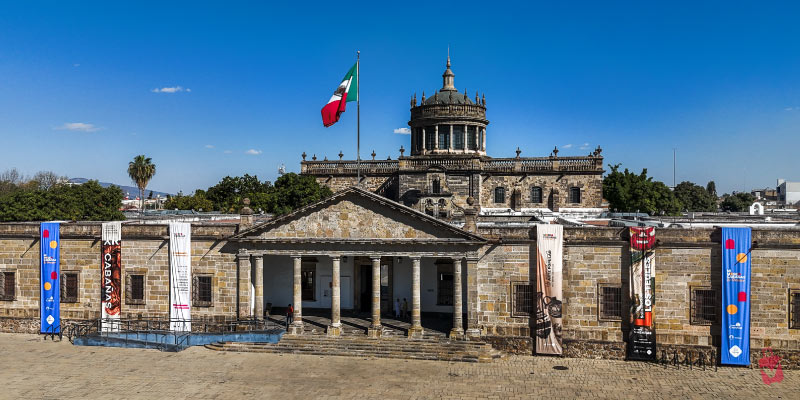
Founded in 1791 by Bishop Juan Cruz Ruiz de Cabañas, this neoclassical complex was originally built as a home for orphans, the elderly, and the infirm. It is a UNESCO World Heritage site, most famous today for housing the masterpiece murals of José Clemente Orozco, including the iconic Man of Fire. It served as a hospital and asylum for nearly two centuries before becoming a cultural center.
Cabañas Museum (Hospicio Cabañas)
Things to Do in Cabañas Museum
Walk through the main courtyards to see the original hospital layout
View José Clemente Orozco’s murals, including The Man of Fire in the central dome
Explore temporary exhibitions on Mexican art and history
Read on-site panels explaining the building’s role as a social welfare institution
2. Guadalajara’s Cathedral
Address: Av. Alcalde 10, Zona Centro, 44100 Guadalajara, Jal.
Visiting Hours: Daily, 8:00 AM – 8:00 PM.
Entry Cost: Free.
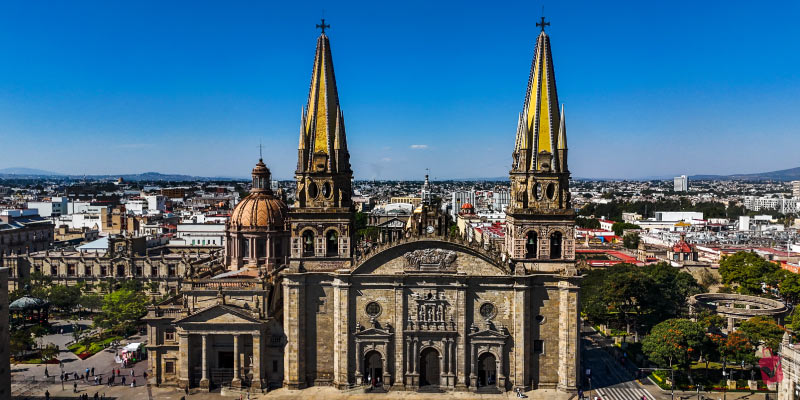
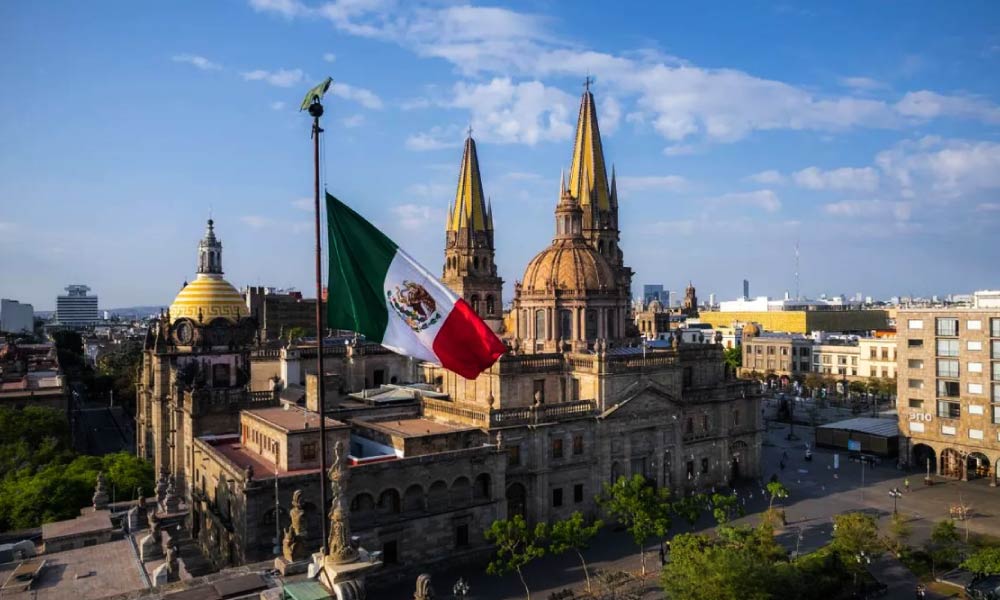
Constructed between 1561 and 1618, the cathedral is the soul of the city. Its history is marked by resilience; it has been damaged by numerous earthquakes over the centuries. This resulted in its unique architectural “mismatch” – the iconic yellow tile towers were actually added in the mid-19th century after the originals collapsed in an 1818 quake.
Guadalajara’s Cathedral (Catedral de Guadalajara)
Things to Do in Guadalajara’s Cathedral
Enter the cathedral to see the main altar and side chapels
Walk around the exterior to observe architectural changes from different reconstruction periods
Visit during daytime hours to avoid service times
Use the cathedral as a central reference point when navigating the historic center
3. Guachimontones Archaeological Site
Address: Carretera Estatal 604, Teuchitlán, Jal. (Approx. 1 hour west of Guadalajara).
Visiting Hours: Tuesday to Sunday, 9:00 AM – 5:00 PM. (Closed Mondays).
Entry Cost:
General: $30 MXN.
Students/Teachers: 50% discount.
Children under 12 and Seniors (INAPAM): Free.
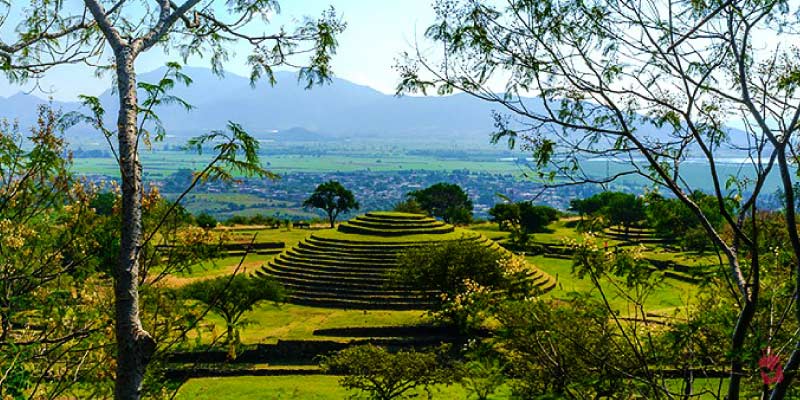
This site dates back to the Teuchitlán tradition (300 BCE – 900 CE). It is globally unique because of its circular stepped pyramids. Unlike the square pyramids of the Aztecs or Mayans, these circular structures were designed to honor the wind god, Ehecatl. The site remained largely hidden under debris and vegetation until formal excavations began in the 1990s.
Guachimontones Archaeological Site
Things to Do in Guachimontones
Walk around the circular ceremonial structures to understand the site’s unique layout
Visit the on-site interpretation center for background on the Teuchitlán culture
Follow marked paths for views of the surrounding valley
Plan for about half a day, including travel time from Guadalajara
4. State of Jalisco Government Building
Address: Av. Ramón Corona 31, Zona Centro, 44100 Guadalajara, Jal.
Visiting Hours: Monday to Friday, 9:00 AM – 5:00 PM. (Usually closed to the public on weekends).
Entry Cost: Free.
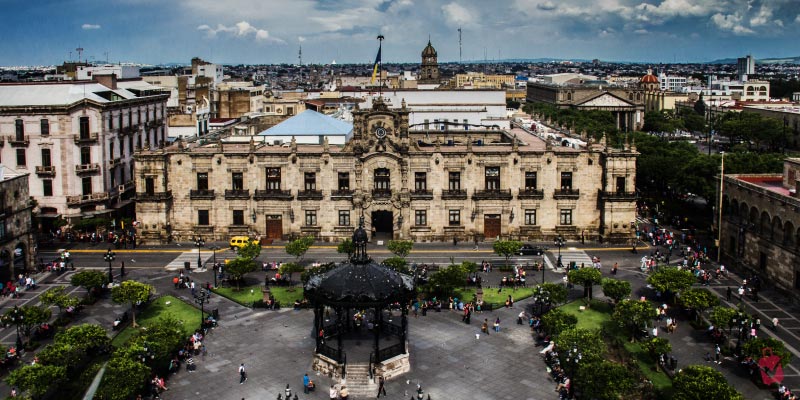
Built in the 18th century, this palace served as the seat of the Spanish government in the region. Its most significant historical moment occurred in 1810, when Miguel Hidalgo (the father of Mexican Independence) signed the decree to abolish slavery within these walls. It also features massive, dramatic murals by Orozco.
State of Jalisco Government Building (Palacio de Gobierno)
Things to Do in The Jalisco Government Building
Enter the main hall to view historical murals
Walk through public corridors that are open during office hours
Note the building’s location facing the main square
Combine the visit with nearby landmarks on foot
5. Teatro Degollado
Address: C. Degollado s/n, Zona Centro, 44100 Guadalajara, Jal.
Visiting Hours: Tours are usually available Monday to Sunday, 10:00 AM – 3:00 PM, provided there are no rehearsals or events.
Entry Cost:
Lobby access is often free.
Guided tours inside the main hall: Approx. $20–$50 MXN.
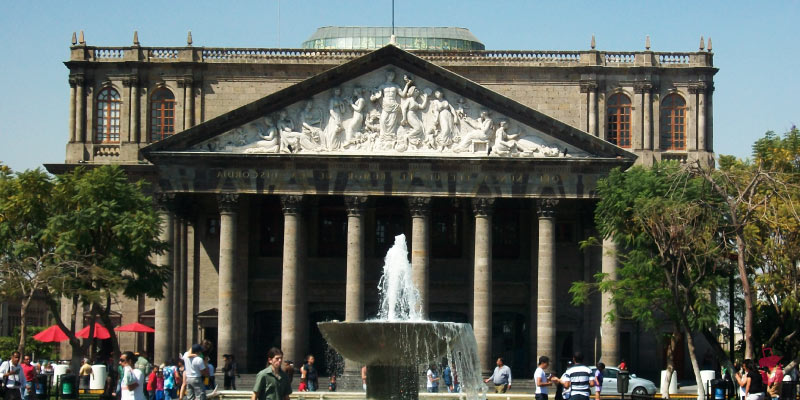
This neoclassical opera house opened in 1866 during Mexico’s Second Empire. It was named after Santos Degollado, a general and governor who championed its construction. Legend says that the golden eagle atop the stage holds a chain in its beak; if the eagle ever drops the chain, the theater will collapse and the city’s “fall” will begin.
Teatro Degollado
Things to Do in Teatro Degollado
Check out the outside first. It’s classic neoclassical style, but the lobby inside is even more interesting
If there’s a performance, go in. Ballet, opera, or orchestra. The locals love it
Look up at the ceiling murals. So many people miss them if they rush
Walk around the plaza and feel how this theater is part of the city’s cultural life
6. Basílica de Nuestra Señora de Zapopan
Address: Calle Eva Briseño 152, Zapopan Centro, 45100 Zapopan, Jal.
Visiting Hours: Daily, 7:00 AM – 8:00 PM.
Entry Cost: Free. (The attached Huichol Art Museum has a small fee of approx. $20 MXN.)
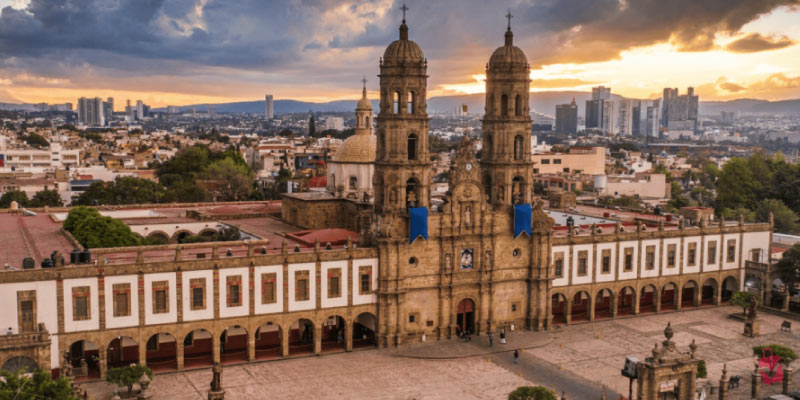
Completed in 1730, this is one of the most visited sanctuaries in Mexico. It houses a small, wooden statue of the Virgin Mary brought by Franciscan friars in the 16th century. Every October 12th, millions of pilgrims participate in the Romería, a massive procession carrying the statue from the Cathedral back to this Basilica.
Basílica de Nuestra Señora de Zapopan
Things to Do in Basílica de Nuestra Señora de Zapopan
If you’re here during a procession, follow the Virgin of Zapopan. It’s huge and really a local tradition
Inside, notice the altars, paintings, and sculptures. They’re centuries old
Don’t skip the little museum next door. It explains why the Virgin is so important to the city
Walk around the plaza to watch locals, see vendors, and get a sense of daily life here
7. Museo Panteón de Belén
Address: C. Belén 684, El Retiro, 44100 Guadalajara, Jal.
Visiting Hours: Tuesday to Saturday; From 10:00 AM to 2:00 PM for a day tour. and 8:30 PM to 11:30 PM for the popular night tour.
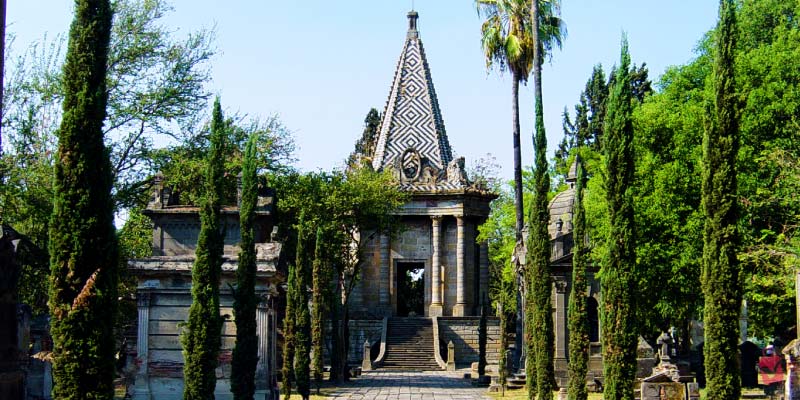
This 19th-century cemetery (opened in 1848) is a masterpiece of funerary architecture. Originally divided into sections for the wealthy and the poor, it was closed for burials in 1896. Today, it is a museum famous for its legends of vampires, pirates, and ghosts, as well as being the final resting place of many prominent Jalisco figures.
Museo Panteón de Belén
Things to Do in Museo Panteón de Belén
Walk the paths to see the old mausoleums. The tomb designs tell a lot about the people who lived here
Check the inscriptions. They mix European and local styles in interesting ways
The info panels explain the cemetery’s role in public health reforms. Makes you see history differently
Notice the stories of merchants, politicians, and other locals buried here. It’s a peek into real Guadalajara life
8. Mercado Libertad (San Juan de Dios)
Address: C. Dionisio Rodríguez 52, San Juan de Dios, 44360 Guadalajara, Jal.
Visiting Hours: Daily, 8:00 AM – 8:00 PM.
Entry Cost: Free
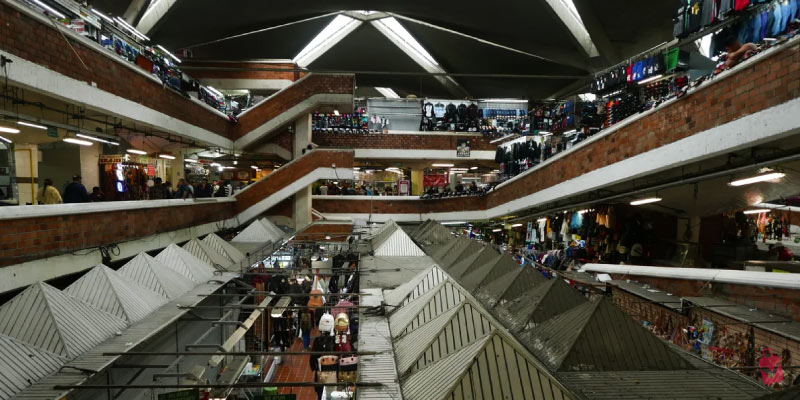
Opened in 1958, this is the largest indoor market in Latin America. It was designed by architect Alejandro Zohn. Historically, it sits on a site that has been a trading hub since the colonial era. Its “hanging” roof structure was a feat of engineering at the time, allowing for vast open spaces without many supporting columns.
Mercado Libertad (San Juan de Dios)
Things to Do in Mercado Libertad
Take your time walking through the floors. It’s huge and each level has something different
Try tortas ahogadas or fresh tamales. They’re local favorites and inexpensive
Browse crafts, textiles, and other goods. Many vendors have been here for generations
Talk to the sellers if you can. They’ll tell you about the market’s history and products. It’s part of the experience
9. Puente de las Damas (Ladies' Bridge)
Address: C. Colón 570, Mexicaltzingo, 44190 Guadalajara, Jal.
Visiting Hours: Tuesday to Sunday, 10:00 AM – 6:00 PM.
Entry Cost: Free.
This colonial-era bridge was built in the 1790s. It was funded by wealthy women of the city who wanted a safe way to cross the San Juan de Dios river to visit a shrine on the other side. As the city grew and the river was diverted into pipes, the bridge was buried and forgotten until it was rediscovered during construction in 2016.
Puente de las Damas (Ladies' Bridge)
Things to do in Puente de las Damas
This one’s easy to miss, but the stone bridge shows how neighborhoods were connected back in colonial times
Read the info panels. The story of its rediscovery is actually pretty interesting
Walk the bridge slowly and imagine how people crossed here hundreds of years ago
Pair it with a downtown walking tour. You’ll see layers of history all around it
10. Mezcala Island (Isla de Mezcala)
Address: Access via the pier (Malecón) in the town of Mezcala de la Asunción (Lake Chapala).
Visiting Hours: Local boat tour (Departing Time) from 10:00 Am to 11:00 AM
Entry Cost: The island is free, but you must pay for a boat. A private boat for a group usually costs between $400 and $600 MXN (round trip).
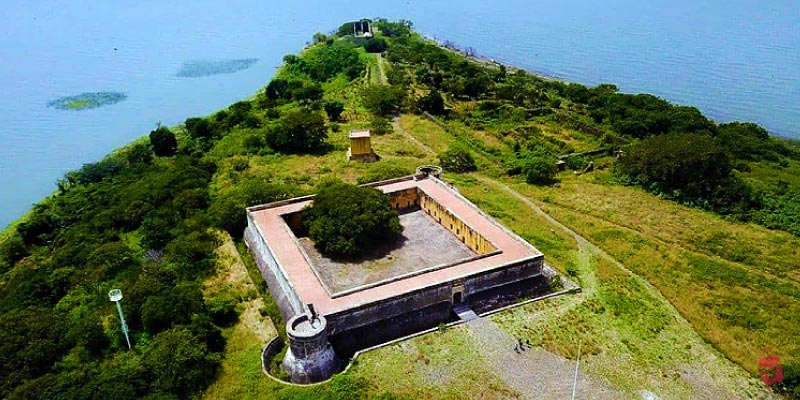
Located in Lake Chapala, this island was an indigenous stronghold during the Mexican War of Independence. Between 1812 and 1816, a small group of rebels successfully defended the island against the Spanish crown for four years without ever being defeated in battle (they eventually surrendered due to sickness and lack of food). It later served as a high-security prison.
Mezcala Island (Isla de Mezcala)
Things to Do in Mezcala Island
Take the boat from the lakeside town. It’s half the fun and gives a good view of Lake Chapala
Walk the trails to explore ruins and lookout points. The forts tell stories of resistance
Learn about the battles and history that happened here. It’s not in most guidebooks
Take a moment to notice the plants and wildlife. The island has its own calm, natural side
Final Thoughts
Plan your itinerary based on your interests and time, whether it’s exploring murals at Cabañas Museum, wandering through the bustling Mercado Libertad, or walking along centuries-old bridges. Each landmark in Guadalajara tells a story, and together they give a deeper understanding of this city of Mexico that doesn’t rely on hype or crowds.
Take your time, enjoy the details, and let the city’s history guide your journey.
Some of the most famous landmarks include Cabañas Museum, Guadalajara Cathedral, Teatro Degollado, Mercado Libertad, and Basílica de Nuestra Señora de Zapopan.
The Guadalajara Historic District is centered around the city’s main square, Plaza de Armas, and includes the Cathedral, Palacio de Gobierno, and Teatro Degollado.
The Cathedral is the religious and cultural heart of the city, built between 1561 and 1618, showcasing architecture from different reconstruction periods due to earthquake damage.
Margaret C. Jones, a passionate explorer of North America, captivates readers with her vivid tales on Travelarii’s blog. With a keen eye for hidden gems and local culture, Margaret offers expert advice and unique insights to enhance your travel experience. Her stories bring the diverse landscapes and vibrant cities of North America to life, inspiring readers to embark on their own adventures.