Mexico City sees over 9 million visitors annually. A large share of them spend their evenings eating at the same tourist restaurants and calling it a night by 10 PM.
The things to do in Mexico City at night are spread across neighborhoods with different energy, different price points, and different crowd types. Roma Norte stays active past midnight. Coyoacán wraps up earlier but offers something quieter and more local. Centro Histórico is best avoided after 10 PM entirely.
Most FIFA World Cup 2026 visitors arriving for matches at Estadio Azteca this June will plan their days and leave their nights open. Fans who lock in Mexico City hotels close to Estadio Azteca early have match days covered. The nights are a different story; Roma Norte and Condesa are where the city opens up, roughly 30 to 40 minutes north by metro.
This guide covers ten nighttime options with honest timing, neighborhood context, and what each one actually feels like after dark.
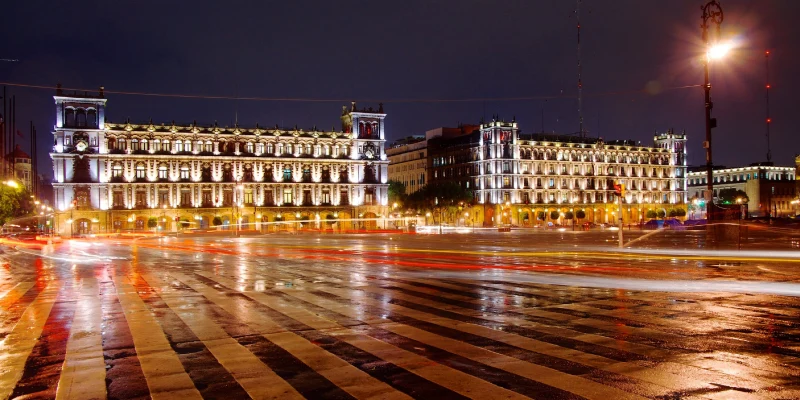
The Historic Center (Centro Histórico) is the heart of Mexico City, built around the Zócalo, one of the largest public squares in the world, and the former center of the Aztec capital Tenochtitlan. Its core plazas, plazas and façades remain visible into the evening thanks to city lighting that helps frame important monuments after sunset.
At night, many parts of the Historic Center continue to see foot traffic from residents and visitors alike, with public lighting and street functions extending visibility well past regular business hours.
Illumination emphasizes the architectural forms of plazas and buildings that might blend into the daytime bustle, making carved stone details and facade profiles stand out against the evening sky.
Walk in the Historic Center (Centro Histórico) at night
Things to do at night:
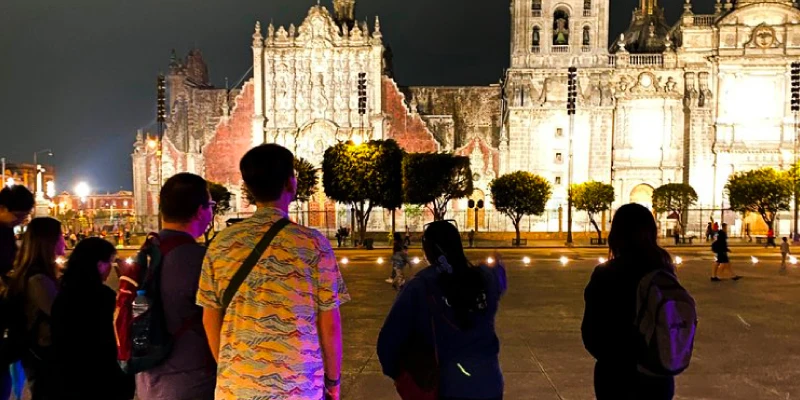
Walk around the Zócalo after dark to see the Metropolitan Cathedral framed by soft lighting and notice details of its Baroque and Renaissance architecture that can be less visible by day.
Follow pedestrian Calle Madero toward Alameda Central through the heart of the district, where evening lights accentuate listed facades and historic signs.
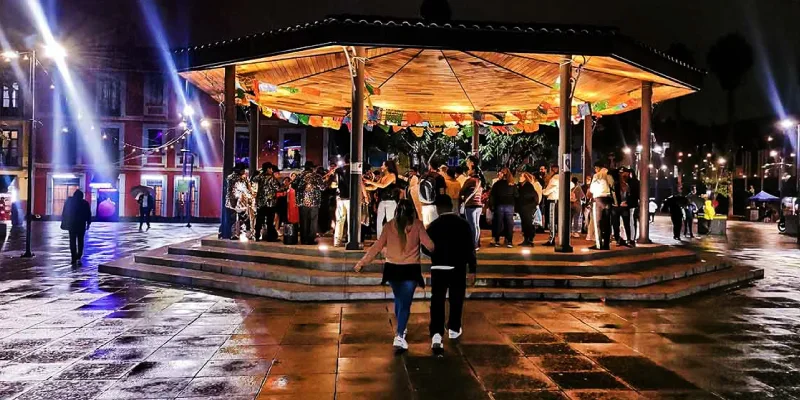
Pause in Plaza Garibaldi, known for its evening mariachi musicians and vendors that stay open into the night, offering snacks and local drinks.
Observe street life around Alameda Central and Palacio de Bellas Artes, where soft glow lighting along walkways highlights monuments and fountains even after most daytime crowds have left.
2. Attend a performance at the Palace of Fine Arts
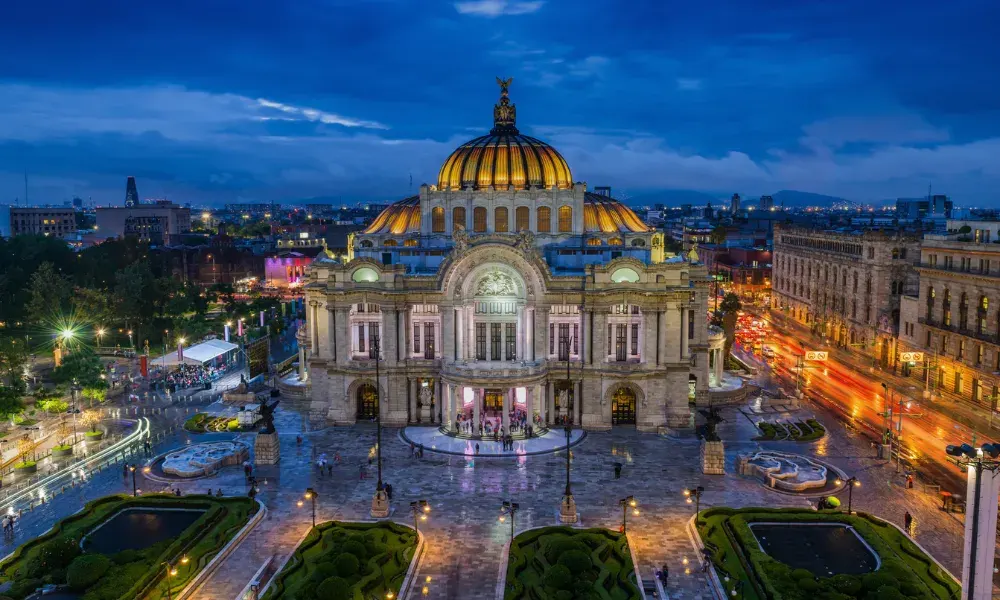
The Palacio de Bellas Artes (Palace of Fine Arts) hosts an active schedule of evening performances, including orchestral concerts, opera, theatre, and dance, with many shows starting in the early evening and often listed on the official calendar before nightfall.
Even outside scheduled performances, the palace’s exterior is kept illuminated after sunset so that its layered Art Nouveau and Art Deco construction contrasts against the darker night sky.
Once lit, the Palace’s white marble exterior and large dome become harder to miss, and lighting on sculptural details and reliefs makes ornamental elements more defined against the evening backdrop.
Attend a performance at the Palace of Fine Arts
Things to do at night:
Book an evening performance via the official Bellas Artes calendar and attend ballet, opera, or orchestral shows that typically begin around early evening.
Observe the illuminated exterior from surrounding plazas and walkways to notice how artificial lighting adds depth to reliefs and architectural mouldings.
Pair your visit with a short walk through Alameda Central after the show, enjoying several monuments with subtle lighting and open pathways.
3. Watch a Lucha Libre match at Arena México
Arena México, sometimes called “La Catedral de la Lucha Libre,” is the main venue in Mexico City for Consejo Mundial de Lucha Libre (CMLL) shows and has been hosting them since the modern building opened in 1956.
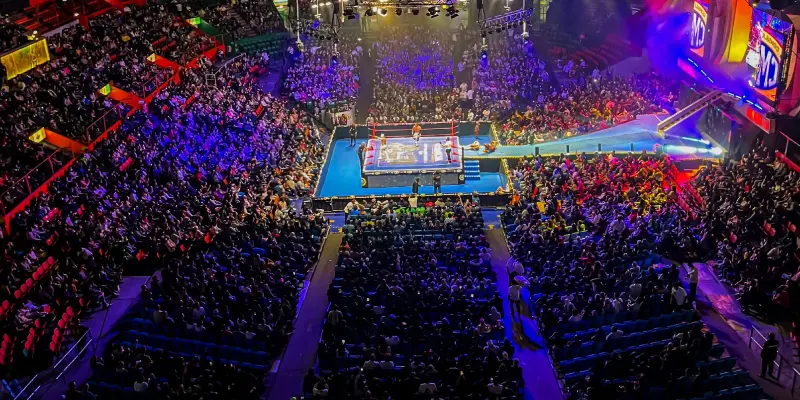
It remains one of the largest dedicated professional wrestling arenas in the world. The venue’s weekly schedule often includes Tuesday and Friday night matches, with the Friday “Super Viernes” show typically starting around 8:30 p.m. and televised nationally.
At night, crowds gather around the arena entrance under exterior lighting, and the contrast between the lit facade and the surrounding streets makes the venue a clear focal point. Inside, the ring’s lights draw focus to the action while the seating area stays partially in shadow, framing the spectacle.
Watch a Lucha Libre match at Arena México
Things to do at night:
Attend a scheduled Tuesday or Friday CMLL show at Arena México, checking match times on the official CMLL or ticketing sites before you go.
Arrive early to browse outside stalls selling merchandise and snacks, giving you time to orient before doors open.
Secure your return transport before leaving, as shows draw large crowds, and arranging a ride‑hail or taxi ahead of time can be easier than waiting after the match.
4. Visit museums with extended evening hours
Mexico City’s Museum Night (Noche de Museos) takes place on the last Wednesday of each month, during which many museums across the city extend their hours into the evening (usually from about 6 p.m. to 10 p.m.) and include special programming like guided tours, film screenings, and workshops.
More than 45 institutions regularly participate in this program, from large venues like the National Museum of Anthropology to smaller niche museums, offering free or discounted access during these nighttime hours.
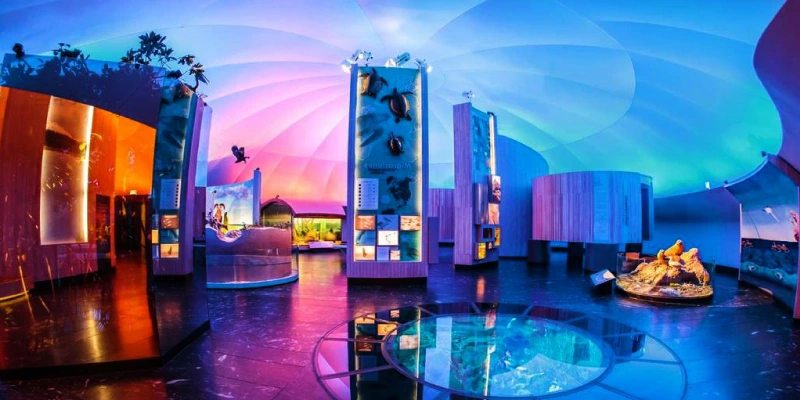
Extended museum hours change the usual pace, letting you see exhibits after typical closing times and allowing quieter galleries and spaces that might be crowded by day to feel more open and accessible. Lighting inside galleries is also designed to highlight exhibits more prominently in the evening format.
Visit museums during Noche de Museos (Museum Night)
Things to do at night:
Participate in Noche de Museos on the last Wednesday of the month, using the official Mexico City program to plan which institutions you want to visit during evening hours.
Visit larger museums like the National Museum of Anthropology or MUNAL while they’re open late and enjoy exhibits with fewer daytime crowds.
Enjoy special evening programming, such as guided tours, concerts or screenings that are scheduled only on Museum Night.
Mix and match stops across participating venues in one evening, using extended hours to cover more than one museum without rushing in daylight.
5. Eat at night markets and street stalls
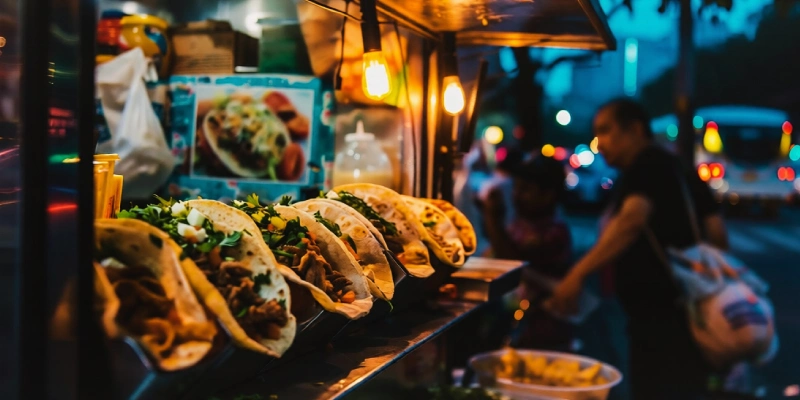
Mexico City’s food scene doesn’t shut down with daylight — street food (“antojitos”) vendors set up in the evenings along key blocks and near market areas, serving traditional snacks like tacos, quesadillas, tamales, and more into the night.
Street food culture here is one of the most extensive in Latin America, and many stalls continue operating well into the evening after the main daytime meal ends. Plaza Garibaldi’s Mercado San Camilito is an all‑night food market that runs 24 hours a day, with dozens of eateries in a row offering birria, tepache and other dishes even late at night.
Under strings of lights and illuminated stall signs, street vendors transform stretches of pavement into lively avenues of sight, sound, and smell. The contrast of artificial lighting with darkened streets highlights the smoke rising from grills and warm comales, which becomes part of the sensory experience that draws people to these spots after dark.
Eat at night markets and street food stalls
Things to do at night:
Sample classic antojitos from late‑night stalls — seek out tacos, quesadillas, tlacoyos and gorditas from vendors that stay open into the evening or night.
Visit Mercado San Camilito near Plaza Garibaldi, where dozens of food‑oriented eateries operate around the clock.
Walk through neighborhood food clusters (e.g., Roma Norte and Condesa) and try different street‑side treats as you move between blocks.
Pair food with local drinks — grab a fresh agua fresca or fermented tepache at a stall to balance spicy snacks.
6. Take a guided night walk
Guided night walking tours of Mexico City offer a structured way to see key areas once the crowds thin and buildings are illuminated. Many tours start from the Palacio de Bellas Artes and proceed through the Historic Center, with commentary on architecture and history that’s tailored to evening conditions.
On these outings, guides point out neoclassical and colonial landmarks like the Palacio Postal and Casa de los Azulejos under evening lighting while offering context that’s often missed on daytime walks.
At night, well‑lit façades and pedestrian paths make architectural details more pronounced than in daylight, and shadows emphasize contrasts in reliefs and decorative elements — a different reading of the city’s urban fabric that many guided tours highlight.
Take a guided night walking tour
Things to do at night:
Join an evening walking tour that navigates through the Historic Center, learning about major landmarks by nightlight.
Listen to stories about key buildings, from the Palacio de Bellas Artes to the Post Office and Casa de los Azulejos, as the group moves through historic avenues.
Take optional vantage points or stops, such as views toward the Torre Latinoamericana or other illuminated rooftops.
Focus on quieter side streets and alleys that feel different after dark and can offer photographic moments with less daytime foot traffic.
7. Go up Torre Latinoamericana for night views
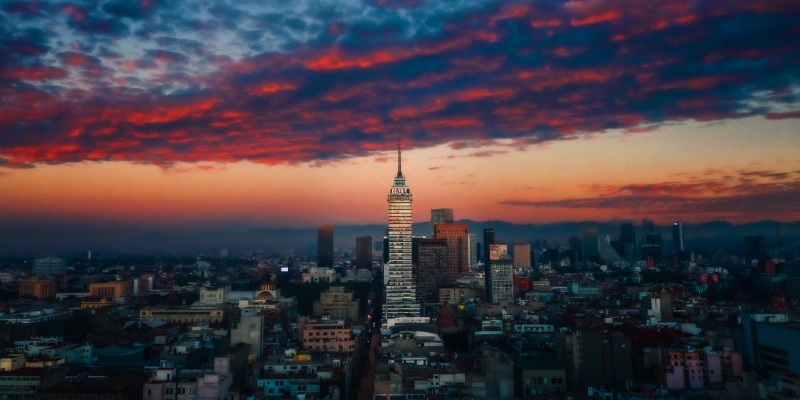
The Torre Latinoamericana is one of Mexico City’s most iconic skyscrapers, completed in 1956 and historically significant as one of the earliest tall buildings in the city centre. Its central location in the Historic Center and strong structural design have made it a defining landmark.
The tower’s observation deck is open to visitors and offers panoramic looks out over the city, with views that encompass the Zócalo, Palacio de Bellas Artes, Chapultepec area and more, making it a compelling evening viewpoint.
At night, the city’s street grid and landmark lighting transform into a field of lights extending to the horizon, and the height of the Torre Latinoamericana means that these lights can be appreciated in full detail from above, with major avenues and plazas visible as lit pathways.
Go up Torre Latinoamericana for night views
Things to do at night:
Buy an admission ticket to the observation deck and ascend the tower as daylight fades for changing city panoramas.
Look out across famous plazas and routes, like the Zócalo and Paseo de la Reforma, illuminated at night.
Photograph the city‑wide lights where street patterns and neighborhood clusters form a grid of visual interest.
Plan your visit for dusk or early evening to see the transition from sunset hues to the city’s night lights.
8. Spend time in Parque Lincoln
Parque Lincoln is a well‑known urban park in the Polanco neighbourhood of Mexico City, named after Abraham Lincoln and featuring reflecting pools, a clock tower, and the Teatro Ángela Peralta open‑air amphitheatre. It was opened in 1938 and remains one of Polanco’s principal green spaces.
The park operates late into the evening, and paths and open areas often see people lingering after sunset, whether sitting by the pools or walking along tree‑lined promenades.
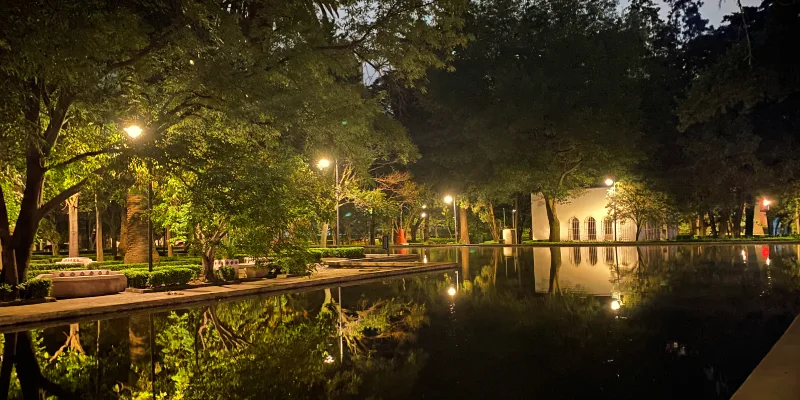
Evening light in Parque Lincoln softens the formal geometry of paths and water features, and illuminated clock towers or street lamps cast reflections on the central ponds. These effects lend a calmer ambience compared to daytime activity, making it comfortable for lingering post‑sunset.
Spend time in Parque Lincoln
Things to do at night:
Walk around the reflecting pools and open lawns to take in how lights highlight water surfaces and shadow lines.
Pause by the clock tower or Teatro Ángela Peralta to observe architectural elements under subdued lighting.
Sit on benches near the aviary or planted edges to enjoy the quieter park atmosphere as the city winds down after dark.
Pair your after‑dinner walk with nearby cafés or streets in Polanco, making it an easy stop between activities.
9. Go out in Roma and Condesa
Roma and Condesa are adjacent neighborhoods in Mexico City that come alive in the evenings with a mix of restaurants, bars, and nightlife spots, attracting both locals and visitors looking for dinner, drinks, and social energy after dark. Roma has a notable variety of eateries and nightlife venues, while Condesa is known for its leafy avenues that ease into vibrant bar scenes at night.
These areas are walkable on foot and well‑connected by taxis, ride‑hails, and public transit, making it feasible to start in one neighborhood in the early evening and move between spots without complex logistics.
Once the sun sets, restaurant and bar façades light up streets like Álvaro Obregón and Tamaulipas, drawing attention to architectural details from Porfirian and Art Deco eras that are less noticeable in daylight.
Explore nightlife in Roma and Condesa
Things to do at night:
Have dinner at a local restaurant in Roma or Condesa before nightlife begins; these neighborhoods are known for high‑quality food options with varied price points.
Visit bars along Álvaro Obregón or Tamaulipas streets to sample crafted cocktails and regional spirits.
Walk between Praça Roma and Parque México after dinner to take in the atmospheric streets that feel distinctly alive at night.
Check out live music or dance venues in Roma Norte, where small stages and DJ sets often run into the late hours.
10. Listen to mariachi music in Plaza Garibaldi
Plaza Garibaldi is a historic square just north of the Palacio de Bellas Artes that has long served as a gathering point for mariachi bands — groups of musicians known for traditional Mexican music — who play both day and night. The practice dates back decades and has made the plaza a recognizable cultural landmark.
At night, groups of mariachis roam the square and surrounding cantinas, offering songs to passersby for a few pesos or a tip, and the area’s lighting has been improved in recent years to support pedestrian use and performances in the evening.
After dark, the square’s open space and surrounding colonial façades are illuminated by street lamps and signage, which helps bring out the texture and shapes of the architecture. This lighting also makes it easier to see individual performers and small crowds gathered around them against the evening atmosphere.
Listen to mariachi music in Plaza Garibaldi
Things to do at night:
Listen to roaming mariachi bands in the plaza as groups play classic rancheras and other traditional songs while inviting listeners to join in or request pieces.
Step into one of the historic cantinas around the square, such as Salón Tenampa, to enjoy live music indoors with drinks and local hospitality.
Watch bands compete for listeners’ attention, with different mariachi groups tuning and performing in various corners of the square.
Pair the music with traditional snacks or beverages from nearby vendors or cantinas as the evening continues and the square stays active.
Conclusion
The activities highlighted show that Mexico City’s nights are structured for both engagement and clarity. Walking the Historic Center, enjoying mariachi music, visiting elevated viewpoints, or sampling street food all reveal a city that rewards intentional exploration after dark.
Collectively, these experiences demonstrate how thoughtful planning can turn potential confusion into meaningful evenings, allowing visitors to interact with the city safely and efficiently.
Understanding which options align with your schedule and interests matters because it transforms nights from uncertain hours into purposeful moments of connection with local culture. Approaching Mexico City with this framework encourages each evening to be both manageable and richly engaging.
Stick to well-lit streets, use ride-hailing apps for longer trips, and focus on neighborhoods like the Historic Center, Roma, and Condesa for a secure evening experience.
Nighttime offers panoramic views of the city’s illuminated streets and landmarks, giving a perspective that is different and more striking than during the day.
Margaret C. Jones, a passionate explorer of North America, captivates readers with her vivid tales on Travelarii’s blog. With a keen eye for hidden gems and local culture, Margaret offers expert advice and unique insights to enhance your travel experience. Her stories bring the diverse landscapes and vibrant cities of North America to life, inspiring readers to embark on their own adventures.