
Driving from Pensacola to Key West covers roughly 800 miles, depending on the route, and can take well over 12 hours without accounting for stops. That distance highlights the main challenge of planning a Florida road trip: the state looks manageable on a map, but fitting its major regions into one trip can mean spending more time behind the wheel than expected.
The better approach is to choose a route that matches the time available. A week can work for a focused stretch of Florida, while 10 to 14 days gives you room to connect several major destinations without turning every day into a driving day. Longer trips can combine the Panhandle, Gulf Coast, central Florida and the Keys.
Find the Right Vacation Rental
Traveling with family, friends, or as a couple? Compare verified rentals that fit your budget and travel style. Choose a place that feels right before you book.
This guide breaks down the main Florida road trip routes, how many days to allow, where to stop, what a Florida road trip with kids can look like, and ways to keep the budget under control. It also gives you a practical Florida road trip map framework so you can see how the pieces fit together. For multi-stop trips, vacation rentals through Travelarii can also make planning easier when staying in several cities, particularly for groups that need more space than a standard hotel room.
| Worldwide Most Popular Travel Destinations |
|---|
Table of Content
- How Many Days Do You Need for a Florida Road Trip?
- Best Florida Road Trip Routes
- East Coast vs. Gulf Coast Florida Road Trip
- Sample Florida Road Trip Itineraries by Length
- Florida Road Trip Map
- Florida Road Trip on a Budget
- Florida Road Trip with Kids
- Where to Stay Along the Way
- Frequently Asked Questions
- More Related Blogs From Travel Recommendations
How Many Days Do You Need for a Florida Road Trip?
A Florida road trip needs a minimum of 5 days for one coast, 7–10 days to cover both coasts, and around 14 days for a full loop that includes the Panhandle, Gulf Coast, Florida Keys, and Atlantic Coast. With fewer days, it is usually better to focus on one region rather than spend most of the trip driving.
Florida Road Trip Length at a Glance
| Trip length | What you can realistically cover |
|---|---|
| 3–4 days | One region only, such as Miami to Key West or Orlando to Tampa |
| 5–7 days | One coast end to end, with selected stops |
| 8–10 days | Both coasts, with part of the Panhandle |
| 12–14 days | A full loop covering the Panhandle, Gulf Coast, Keys, and East Coast |
The right number of days depends less on how much ground you can physically cover and more on how much time you want outside the car. Florida’s major destinations are spread widely across the state, and a route that looks straightforward on a Florida road trip map can involve several hours of driving between stops.
For a trip focused on sightseeing, 120 to 180 miles of driving per day is a practical target. That leaves enough time for beaches, attractions, meals, short walks, and unexpected stops. Longer driving days are possible, particularly when moving between major cities, but scheduling them repeatedly can turn a road trip into a series of highway transfers.
3–4 Days: Choose One Region
With only a few days available, avoid trying to connect Miami, Orlando, Tampa, and the Keys. Pick a compact route instead.
A Miami to Key West trip works well for a short South Florida itinerary. You can spend time in Miami, drive through the Florida Keys, and finish in Key West. Another option is an Orlando to Tampa route, which gives you access to central Florida attractions and the Gulf Coast without requiring long cross-state drives.
This approach also makes sense for travelers flying into Florida. A rental car can give you flexibility within one region without committing to a full-state itinerary.
5–7 Days: Follow One Coast
A week gives you enough time to build one of the best Florida road trip routes around either the Gulf Coast or Atlantic Coast.
On the Gulf Coast, a route could connect Tampa, Sarasota, Fort Myers, Naples, and the Everglades area. On the East Coast, you could travel between Miami, Fort Lauderdale, Palm Beach, Daytona Beach, and Jacksonville, depending on how far north you want to go.
You will still need to make choices. Trying to include every major city in seven days usually means arriving, checking in, and leaving again before having much time to explore.
8–10 Days: Combine the Coasts
With eight to ten days, a cross-state itinerary becomes more practical. You could begin in Miami, travel north along the Atlantic Coast, cross through central Florida, then return south along the Gulf Coast.
Another option is to dedicate several days to South Florida and the Keys, then head toward the Gulf Coast for a second section of the trip.
This is a good range for travelers who want variety without committing to the longest version of a Florida road trip. You can include major cities and beaches while still leaving space for a few slower days.
12–14 Days: Complete the Loop
Two weeks is a much better target for a full Florida road trip itinerary. A longer loop can start in the Panhandle, follow the Gulf Coast toward Tampa and Naples, continue through South Florida and the Keys, then return north along the Atlantic side.
A rough route might look like:
Pensacola → Destin → Tampa → Sarasota → Naples → Miami → Key West → Fort Lauderdale → Palm Beach → Daytona Beach → Jacksonville → Panhandle
You do not need to stop in every destination. The value of a 12–14-day itinerary is that you can select the places that fit your interests while keeping daily driving manageable.
A full loop also makes more sense when your arrival and departure airports are flexible. Otherwise, you may spend several hours returning to your starting point simply to catch a flight.
What Is the Best Length for a Florida Road Trip?
For most travelers, 7–10 days is the sweet spot. It is long enough to experience more than one part of the state but short enough to fit into a typical vacation schedule.
Families may prefer 7–10 days with fewer hotel changes, while couples or small groups with more flexibility may find 10–14 days worthwhile. If the trip is primarily about the Florida Keys, Miami, or a particular stretch of coastline, there is little reason to force a full-state loop into the schedule.
The key is to build the itinerary around the places you actually want to visit, then use the available days to determine how far the route should extend. That usually produces a better trip than starting with a list of every major Florida destination and trying to fit them all in.
Best Florida Road Trip Routes
Florida is long enough that choosing a route can change the entire character of the trip. A drive from Jacksonville to Miami focuses on Atlantic beaches and historic cities, while a Gulf Coast route puts more emphasis on quieter shoreline stops and west-coast sunsets. Travelers with more time can combine both into a full-state loop, while an inland detour through Orlando works well for trips built around theme parks.
Here are the best Florida road trip routes to consider based on driving time, stops, and the type of trip you want.
The East Coast Route: Jacksonville to Miami
The Atlantic coast is one of the easiest places to build a Florida road trip itinerary because the major destinations are connected by I-95, US-1, and A1A. The Jacksonville-to-Miami drive is roughly 375 miles without major detours, but a route that includes the main coastal stops will cover more ground.
Suggested route: Jacksonville → St. Augustine → Daytona Beach → Palm Beach → Fort Lauderdale → Miami
Start in Jacksonville and head south toward St. Augustine, the oldest continuously inhabited European-founded city in the continental United States. Its compact historic district makes it a useful first overnight stop, particularly if you want to break up the drive rather than cover the entire coast in one day.
Continue to Daytona Beach, where the coastline, Daytona International Speedway, and the nearby communities give the route a different feel from St. Augustine. From here, you can stay close to the Atlantic on sections of A1A or use I-95 when you want to make better time.
Further south, Palm Beach is a good place to slow the pace for a day. The area is known for upscale shopping, beaches, historic architecture, and nearby West Palm Beach. Fort Lauderdale then gives you another coastal base before the final drive to Miami.
For travelers who want to see several major Florida destinations without constantly changing hotels, this is one of the more straightforward routes. I-95 also gives you a practical alternative when coastal roads become slow or congested.
Best for: Travelers who want a relatively easy drive combining historic cities, Atlantic beaches, and major South Florida destinations.
The Gulf Coast Route: Pensacola to Naples
The Gulf Coast route works well for travelers who want to spend more time around beaches, waterfront towns, and resort areas. It is considerably longer than the Jacksonville-to-Miami drive, with a direct Pensacola-to-Naples journey already covering roughly 750 miles depending on the roads and stops you choose.
Suggested route: Pensacola → Destin → Panama City Beach → Tampa/St. Pete → Sarasota → Fort Myers → Naples
Begin in Pensacola, in Florida’s western Panhandle, then follow the coast toward Destin. The Panhandle is known for its Gulf beaches and small coastal communities, and the relatively short distances between several stops make it easy to build in beach days without driving for hours every day.
Panama City Beach can be added after Destin if you want another Gulf Coast stop before heading farther south. From there, the route becomes more urban as you approach the Tampa Bay area.
Tampa and St. Petersburg are useful as a two-city stop rather than simply a place to pass through. Tampa has museums, restaurants, sports venues, and family attractions, while St. Petersburg provides access to beaches and the waterfront. You can spend two or three nights here and use the area as a base instead of moving accommodation every day.
Continue south to Sarasota, which makes a convenient stop between Tampa Bay and Southwest Florida. After Sarasota, the route heads toward Fort Myers and then Naples. These final sections are better suited to travelers who want a slower coastal itinerary, with time for beaches, parks, boating, and waterfront dining.
One practical point: the Gulf Coast route is not one continuous scenic highway. In several sections, inland interstates are the fastest option, while shorter coastal roads can add considerable driving time. Your exact route should depend on whether the priority is reaching the next destination or spending more time along the shoreline.
Best for: Families and beach-focused travelers who prefer Gulf Coast communities, resort areas, and a slower pace between major stops.
The Panhandle-to-Keys Loop
For travelers with 10 days or more, a full-state loop can provide a much broader view of Florida than choosing a single coast. This route combines the Panhandle, Gulf Coast, Central Florida, Atlantic Coast, and the Florida Keys before returning north.
Suggested route: Pensacola → Destin → Tampa/St. Pete → Sarasota → Naples → Miami → Florida Keys → Fort Lauderdale/Palm Beach → Daytona Beach → St. Augustine → Jacksonville
The first part follows the Gulf Coast from the western Panhandle toward Southwest Florida. After Naples, continue to Miami and then take US-1 south through the Florida Keys.
The Overseas Highway is the defining section of this route. US-1 connects the Florida Keys with the mainland, crossing a long chain of islands before reaching Key West. Because the drive from Miami to Key West is roughly 160 miles, it is possible to do in a day, but spending at least one or two nights in the Keys makes more sense for most road trips.
After returning to mainland Florida, you can head north along the Atlantic side through Fort Lauderdale, Palm Beach, Daytona Beach, and St. Augustine before finishing in Jacksonville. Travelers starting from another Florida city can simply reverse or modify the loop.
This is the route where a Florida road trip map becomes especially useful. The distances between regions can be substantial, and trying to see every major destination in a short trip can turn the vacation into a sequence of long driving days. With 10 to 14 days, you have more flexibility to spend several nights in selected destinations rather than changing hotels constantly.
Best for: Travelers with 10+ days who want to combine both Florida coasts, Miami, the Keys, and several major cities in one trip.
The Central Florida Detour: Orlando or Tampa Inland Leg
Not every Florida road trip needs to stay on the coast. Adding Orlando to an otherwise coastal itinerary makes sense for travelers who want theme parks, major attractions, shopping, or family entertainment alongside beach destinations.
There are two straightforward ways to add Central Florida to a coastal route.
From the Gulf Coast: After visiting Tampa or St. Petersburg, drive northeast to Orlando before continuing toward the Atlantic coast. Orlando is roughly 85 miles from Tampa, so the detour is manageable. After your Orlando stay, head east toward Daytona Beach and rejoin the Atlantic route.
From the Atlantic Coast: If you are driving south from Jacksonville, visit St. Augustine or Daytona Beach first, then turn inland toward Orlando. After your theme-park days, drive west to Tampa or continue south toward Miami depending on the rest of your itinerary.
For a Florida road trip with kids, this detour can be particularly practical because it separates theme-park days from beach days. Rather than trying to fit Orlando into a single day between coastal stops, give the city its own two- to four-night section and then continue the road trip.
The main trade-off is driving time. Orlando is inland, so adding it to a coastal itinerary creates a few extra hours of driving compared with staying on one coast. The benefit is that you can combine Florida’s major theme-park destinations with either the Gulf or Atlantic shoreline without planning a completely separate vacation.
Best for: Families and theme-park travelers who want to combine Orlando with either the Gulf Coast or Atlantic Coast without abandoning a wider Florida road trip.
East Coast vs. Gulf Coast Florida Road Trip
Choosing between Florida’s two coasts depends largely on how you want to spend your driving days. The East Coast generally makes it easier to connect major cities and beach destinations, while the Gulf Coast suits travelers who want more time around smaller coastal communities and calmer beaches.
| Factor | East Coast | Gulf Coast |
|---|---|---|
| Driving ease | More direct, with I-95 connecting many major destinations | More winding in coastal sections, with scenic routes between towns |
| Beach type | Wider Atlantic beaches, often with more development nearby | Generally calmer Gulf waters, with strong sunset views |
| Traffic | Heavier, particularly around Miami, Fort Lauderdale, West Palm Beach, and other major urban areas | Usually lighter outside peak travel periods, though Tampa and other major cities can still see congestion |
| Vibe | Urban destinations mixed with beach towns | Smaller coastal communities and family-oriented resort areas |
| Best months | November to April | October to May |
Which Florida Coast Should You Choose?
Choose the East Coast if you want a more efficient route between major destinations, historic St. Augustine, Atlantic beach towns, and cities such as Miami and Fort Lauderdale. It is also the stronger option for a shorter trip where you want to cover several places without spending as much time on secondary roads.
Choose the Gulf Coast if beaches, calmer water, sunsets, and resort-style stops matter more than reaching destinations quickly. It works particularly well for families, couples, and travelers who are comfortable giving the route more time.
For a first Florida road trip itinerary, the East Coast is usually easier to manage in five to seven days. The Gulf Coast becomes more appealing when you have a week or longer and want to build in longer stays rather than moving from city to city.
If you have 10 or more days, there is no need to treat the two coasts as an either-or decision. A full-state loop can combine both, with the Florida Keys adding another distinct section to the drive.
Sample Florida Road Trip Itineraries by Length
The right Florida road trip itinerary depends heavily on how much time you have. A three-day weekend calls for one compact region, while seven days gives you enough time to follow one coast without rushing. With 10 to 14 days, you can connect the Panhandle, Gulf Coast, Florida Keys, and Atlantic side into one larger trip.
The itineraries below are starting points rather than fixed schedules. Mileage and drive times are approximate and can change with traffic, road construction, weather, and stops along the way.
3-Day Weekend Itinerary
A three-day Florida road trip works best when you stay within one region. Trying to drive from the Panhandle to Miami in a weekend leaves little time for the places you are actually visiting.
For a compact Atlantic Coast trip, Jacksonville, St. Augustine, and Daytona Beach make a practical combination.
Day 1: Jacksonville to St. Augustine (45 miles, 1 hr)
Start in Jacksonville and drive south to St. Augustine. The short drive gives you most of the day to explore the historic district, waterfront, and nearby beaches.
Stay overnight in St. Augustine rather than continuing farther south. This keeps the first day manageable and gives you a full morning and afternoon in the city.
Day 2: St. Augustine to Daytona Beach (55 miles, 1 hr 15 min)
Leave St. Augustine after breakfast and continue south toward Daytona Beach. Spend the afternoon along the beach or explore attractions around the city.
If motorsports are a priority, allow additional time for Daytona International Speedway. Otherwise, the beach and nearby waterfront areas can fill the afternoon without adding another long drive.
Stay overnight in Daytona Beach.
Day 3: Daytona Beach to Jacksonville (90 miles, 1 hr 30 min)
Use the final morning for Daytona Beach before driving back toward Jacksonville. Depending on your departure time, you can make a short stop along the way or return directly to the airport or your starting point.
Best for: A long weekend focused on Northeast Florida and Atlantic beach towns without spending most of the trip behind the wheel.
7-Day Itinerary: One Coast
Seven days gives you enough time to cover a meaningful stretch of Florida without changing hotels every night. The following Atlantic Coast itinerary combines Jacksonville, St. Augustine, Daytona Beach, Palm Beach, Fort Lauderdale, and Miami.
It also alternates longer driving days with days where you stay in one location, making the schedule easier to manage.
Day 1: Jacksonville to St. Augustine (45 miles, 1 hr)
Begin in Jacksonville and drive south to St. Augustine. Spend the rest of the day exploring the historic district and waterfront.
Stay overnight in St. Augustine.
Day 2: St. Augustine Stay-Put Day
Keep the car parked for most of the day. Use the morning to visit historic sites, then spend the afternoon around the beach or nearby attractions.
A stay-put day this early in the trip helps prevent the itinerary from becoming a sequence of checkouts and long drives.
Day 3: St. Augustine to Daytona Beach (55 miles, 1 hr 15 min)
Head south to Daytona Beach. The short drive leaves plenty of time for the beach, local attractions, or a visit to Daytona International Speedway.
Stay overnight in Daytona Beach.
Day 4: Daytona Beach to West Palm Beach (190 miles, 3 hrs)
This is one of the longer driving days. Take I-95 south toward South Florida and use West Palm Beach as your base for the next two nights.
After checking in, keep the evening simple with dinner and a walk around the waterfront or downtown area.
Day 5: West Palm Beach Stay-Put Day
Spend the day exploring West Palm Beach and nearby Palm Beach. This is a useful break after the longer drive on Day 4.
You can also use the day for a beach visit, shopping, museums, or a slower morning at your accommodation.
Day 6: West Palm Beach to Fort Lauderdale (50 miles, 1 hr)
Continue south to Fort Lauderdale. Traffic can make this drive considerably longer than the distance suggests, so avoid building a tightly timed schedule around the arrival.
Spend the afternoon exploring the waterfront, beaches, or nearby neighborhoods.
Stay overnight in Fort Lauderdale.
Day 7: Fort Lauderdale to Miami (30 miles, 45 min to 1 hr)
Finish the coastal route with a short drive to Miami. Depending on your departure time, you can spend the remainder of the day exploring Miami or use the city as the final overnight stop.
For travelers flying home, Miami International Airport provides a convenient endpoint for the route.
Best for: Travelers with seven days who want to experience several Atlantic Coast destinations while keeping enough time for full days in individual cities.
10–14 Day Full-State Itinerary
A 10- to 14-day trip opens up the possibility of connecting both coasts with the Florida Keys. Rather than treating the entire state as one continuous drive, divide the trip into regional sections.
The first week works well for the Panhandle and Gulf Coast. The second section can then cover Miami, the Keys, and the Atlantic Coast on the return north.
Week 1: Panhandle + Gulf Coast
Day 1: Pensacola to Destin (80 miles, 1 hr 30 min)
Start in Pensacola and drive east toward Destin. Spend the afternoon around the Gulf Coast and stay overnight in Destin.
The relatively short drive gives you time to settle in rather than using the first day entirely for transportation.
Day 2: Destin Stay-Put Day
Spend a full day in Destin. Keep the schedule flexible for beach time, waterfront activities, or nearby state parks.
This is one of the days where staying in the same accommodation pays off. You avoid packing up just as you begin settling into the trip.
Day 3: Destin to Panama City Beach (80 miles, 1 hr 30 min)
Continue east along the Panhandle to Panama City Beach. The drive is short, allowing most of the day for the coast.
Stay overnight in Panama City Beach.
Day 4: Panama City Beach to Tampa (300 miles, 4 hrs 30 min)
This is a longer transfer day. Head south and east toward Tampa, using major highways to cover the distance efficiently.
Once in Tampa, spend the evening around the city rather than planning a packed sightseeing schedule.
Day 5: Tampa Stay-Put Day
Give Tampa a full day. You can explore museums, waterfront areas, restaurants, or nearby attractions without moving the car between cities.
Travelers who want to visit St. Petersburg can use this as a base for a day trip across Tampa Bay.
Day 6: Tampa to Sarasota (60 miles, 1 hr 15 min)
Drive south to Sarasota and spend the afternoon exploring the city and nearby beaches.
Stay overnight in Sarasota.
Day 7: Sarasota to Fort Myers (85 miles, 1 hr 30 min)
Continue south toward Fort Myers. The shorter drive gives you time to stop along the way or spend more of the afternoon at your destination.
Stay overnight in Fort Myers.
Week 2: Southwest Florida to Keys + East Coast Return
For a 10-day trip, you can compress this second section by dropping some overnight stops. A 14-day trip gives you more room for the Keys and Atlantic Coast.
Day 8: Fort Myers to Naples (45 miles, 1 hr)
Drive south to Naples and spend the day around the Gulf Coast. Naples can also work as a base for exploring nearby parks and coastal areas.
Stay overnight in Naples.
Day 9: Naples to Miami (125 miles, 2 hrs 15 min)
Leave Southwest Florida and cross the state toward Miami. The drive is relatively direct compared with following the coastline around the southern tip.
Use the afternoon and evening to explore Miami.
Stay overnight in Miami.
Day 10: Miami to Key West (165 miles, 3 hrs 30 min)
Start the drive south on US-1 toward Key West. The distance is manageable, but the Overseas Highway is a route where frequent stops can extend the journey.
Arrive in Key West with enough time for the waterfront, local restaurants, and an evening around the city.
Stay overnight in Key West.
Day 11: Key West Stay-Put Day
Keep the car parked and spend the day in Key West. A full day here prevents the Keys section from becoming little more than a drive to the end of the highway.
If you have only 10 days, this can also be the point where you begin the return journey.
Day 12: Key West to Fort Lauderdale (190 miles, 4 hrs)
Drive back through the Keys and continue north to Fort Lauderdale.
Because this is a longer return day, plan fewer activities after arrival.
Stay overnight in Fort Lauderdale.
Day 13: Fort Lauderdale to Palm Beach (50 miles, 1 hr)
Continue north along the Atlantic side. Spend the day around Palm Beach and West Palm Beach, using the short drive to your advantage.
Stay overnight in Palm Beach or West Palm Beach.
Day 14: Palm Beach to St. Augustine (300 miles, 4 hrs 30 min)
Finish the full-state route with a longer drive north along Florida’s Atlantic Coast. If Jacksonville is your departure point, continue north after St. Augustine.
For a 14-day trip ending in Jacksonville, you can treat St. Augustine as a final sightseeing stop before the airport or an overnight base.
Best for: Travelers with 10 to 14 days who want to connect Florida’s Panhandle, Gulf Coast, Miami, the Keys, and Atlantic Coast in one road trip.
How to Adjust the Itinerary to Your Trip Length
The biggest mistake with a long Florida road trip is trying to include every major destination. Use the itinerary as a framework and remove stops rather than turning every day into a four-hour transfer.
- For 3 days, stay within one region.
- For 5 to 7 days, choose one coast and spend at least two nights in selected destinations.
- For 10 days, combine one major coastal section with Miami and the Keys, or focus on a shorter full-state loop.
- For 14 days, you can comfortably combine the Panhandle, Gulf Coast, Miami, the Keys, and several Atlantic Coast cities, provided you are comfortable with a few longer driving days.
If you are traveling with children, add more stay-put days. A Florida road trip with kids usually works better when the itinerary has fewer hotel changes and predictable driving stretches, even if that means leaving a destination or two off the map.
Florida Road Trip Map
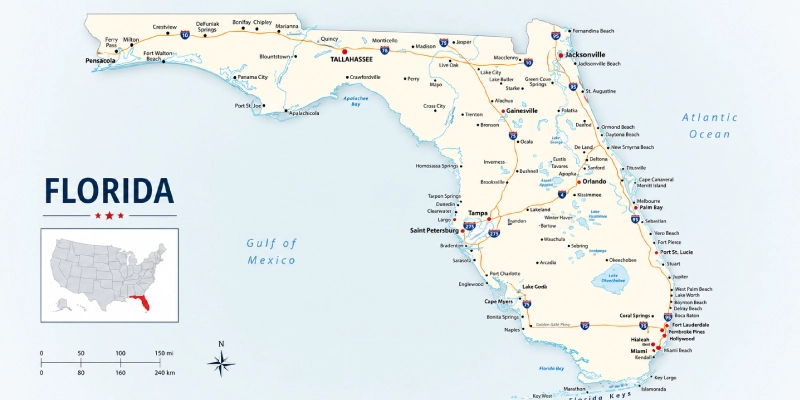
A Florida road trip map makes it easier to see how the state’s major destinations connect before you start booking hotels. Because Florida stretches more than 800 miles from its northern border to Key West, a route that looks simple on a list can involve several long driving days.
For the visual map, place an interactive route map or static graphic here showing the main coastal routes and the full-state loop. The map should clearly mark the major overnight stops rather than attempting to label every town along the way.
Recommended map route:
Panhandle: Pensacola → Destin → Panama City Beach
Gulf Coast: Tampa → St. Petersburg → Sarasota → Fort Myers → Naples
South Florida: Miami → Fort Lauderdale → Palm Beach
Florida Keys: Miami → Key Largo → Marathon → Key West
Atlantic Coast: Palm Beach → Daytona Beach → St. Augustine → Jacksonville
Central Florida option: Tampa → Orlando → Daytona Beach
For the full-state version, the route can be displayed as a loop: Pensacola → Destin → Tampa → Sarasota → Fort Myers → Naples → Miami → Key West → Fort Lauderdale → Palm Beach → Daytona Beach → St. Augustine → Jacksonville.
Florida Road Trip on a Budget
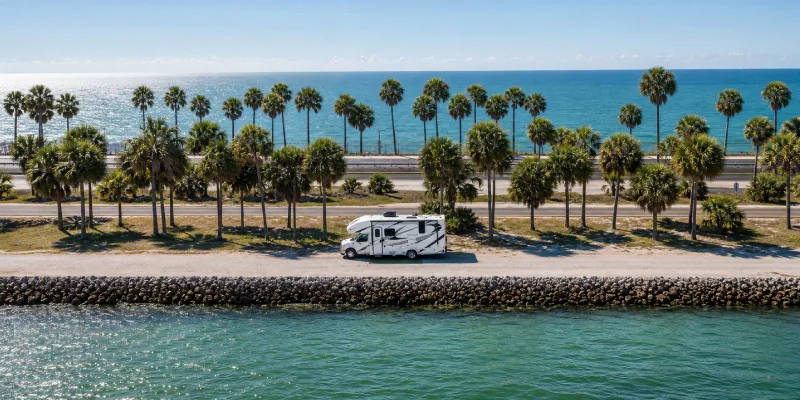
A Florida road trip on a budget is easier to manage when you plan the major expenses before choosing your route. Gas is only one part of the cost. Accommodation, meals, parking, attraction tickets, and the number of times you move between destinations can have a much larger effect on the final total.
The figures below are planning ranges rather than fixed prices. Your actual costs will vary based on vehicle size, fuel prices, travel dates, property type, group size, and the destinations on your route.
Florida Road Trip Cost Breakdown
| Expense | Low Budget | Mid-Range | Higher Budget |
|---|---|---|---|
| Gas | $150–$250 | $250–$400 | $400+ |
| Lodging | $60–$110/night | $120–$220/night | $250+/night |
| Food | $25–$45/person/day | $50–$90/person/day | $100+/person/day |
| Attractions | $0–$25/person/day | $30–$75/person/day | $75+/person/day |
| Parking & tolls | $5–$20/day | $15–$30/day | $30+/day |
For a seven-day trip, a solo traveler or couple staying in budget accommodation and limiting paid attractions could keep daily spending relatively low. A family staying in hotels, eating most meals at restaurants, and visiting major ticketed attractions can spend several times more.
Gas costs are particularly dependent on the length of your route. A three-day Atlantic Coast trip might use far less fuel than a 14-day Panhandle-to-Keys loop, even if both trips use the same rental car.
Travel in the Off-Season
Travel dates can have a significant effect on accommodation costs. Florida’s busiest periods generally include winter travel, spring break, and major holiday periods, when demand can push up hotel and vacation rental prices.
For a lower-cost trip, consider traveling during shoulder or less-demanded periods when weather and your destination plans allow. The Gulf Coast, for example, can be considerably more attractive from a pricing perspective outside its busiest periods.
Before booking, compare the total accommodation cost for your exact dates rather than assuming that a cheaper season automatically means the lowest overall trip cost. Weather, events, and local demand can change prices from one destination to another.
Consider Vacation Rentals Instead of Hotel-Only Stays
Accommodation is often one of the biggest expenses on a multi-city road trip, particularly for families or groups that need more than one hotel room.
Vacation rentals can give you access to kitchens, living areas, laundry facilities, and multiple bedrooms. That can change the economics of a road trip because you can prepare some breakfasts or dinners instead of buying every meal at a restaurant.
Travelarii can be useful when comparing vacation rentals along a Florida route. Instead of treating accommodation as a separate hotel stop in every city, compare available rental properties based on location, space, and amenities. For families or groups, splitting the cost of a larger rental can also make the per-person accommodation cost more manageable.
A kitchen does not mean every meal needs to be cooked. Even using it for breakfast, snacks, drinks, and a few dinners can reduce restaurant spending over a week-long trip.
Use State Parks and Lower-Cost Attractions
Florida has numerous state parks and outdoor areas where the cost of entry can be considerably lower than major commercial attractions. Beaches, walking trails, waterfront areas, historic districts, and public parks can also fill parts of your itinerary without requiring a large admission fee.
This is especially useful on longer trips. You do not need to schedule a paid attraction every day. Alternating ticketed experiences with free or low-cost activities can keep the entertainment budget under control while giving everyone some downtime.
For families, this approach can be particularly useful. A morning at a state park or beach can cost much less than a full day at a major theme park, while also giving children a break from structured attractions.
Reduce Unnecessary Driving
The cheapest route is not always the one with the fewest miles. A poorly planned itinerary can add extra hotel nights, parking charges, meals on the road, and fuel costs.
Choose destinations that make geographic sense. For example, travelers following the Atlantic Coast can move progressively from Jacksonville toward Miami rather than repeatedly driving north and south between cities.
The same principle applies to the Gulf Coast. Group nearby destinations into one section of the trip instead of using a distant city as a base for several long day trips.
A Florida road trip map is useful here because it lets you see the actual relationship between destinations before committing to your hotel bookings.
Compare the Total Cost, Not Just the Nightly Rate
A $90 hotel is not necessarily cheaper than a $130 vacation rental. If the rental sleeps four people and has a kitchen, the overall trip cost could be lower after accommodation and food are included.
When comparing options, look at:
- Total accommodation cost for the entire stay
- Number of travelers the property accommodates
- Kitchen and laundry availability
- Parking fees
- Distance from major attractions
- Cleaning or service fees
- Expected restaurant spending
- Number of nights required on the route
This broader comparison is particularly important for a Florida road trip with kids, where having more space and the ability to prepare simple meals can make both the budget and daily schedule easier to manage.
A Simple Budget Strategy for a Week-Long Road Trip
For a seven-day trip, divide your budget into four main categories before booking anything: transportation, accommodation, food, and activities.
Start with the route and estimate your mileage. Then calculate accommodation based on the number of nights rather than comparing individual nightly prices. Set a daily food allowance and decide which attractions are worth paying for in advance.
Finally, leave a small buffer for parking, tolls, unexpected fuel costs, and spontaneous stops.
For travelers trying to keep costs down, the biggest savings usually come from choosing the right route, limiting unnecessary hotel changes, using vacation rentals strategically, preparing some meals, and mixing paid attractions with low-cost outdoor activities. Those decisions can make a bigger difference than simply searching for the cheapest gas station along the way.
Florida Road Trip with Kids

A Florida road trip with kids works best when you keep driving days short and avoid changing hotels every night. Instead of trying to cover the whole state, focus on a few areas and give each one enough time.
Best Family-Friendly Stops
Orlando is an obvious choice for families because of its theme parks and other attractions. It also works well as a Central Florida stop between Tampa and the Atlantic Coast.
St. Augustine is another good option. Its compact historic area means less driving once you arrive, while nearby beaches give families an easy change of pace.
On the Gulf Coast, Tampa, St. Petersburg, Sarasota, and Fort Myers can work well for families who want beaches, parks, and shorter drives between stops.
Plan Around the Kids’ Schedule
Try to schedule longer drives during nap time or early in the morning. Build a rest stop into longer stretches rather than waiting until everyone needs a break.
For the car, pack snacks, water, small activities, headphones, wipes, and a change of clothes. Keep these items within easy reach instead of putting everything in the trunk.
Avoid planning a major attraction immediately after a long drive. Give everyone time to check in, eat, and settle down first.
Choose Accommodation With More Space
Hotel rooms can become restrictive for families, especially when sharing one room for several nights. A vacation rental can provide separate bedrooms, a kitchen, laundry facilities, and more common space.
Travelarii can help families compare vacation rentals along their route. Having a kitchen can also reduce the need for restaurant meals, while extra space makes longer stays easier to manage.
For family trips, fewer accommodation changes usually make the road trip simpler. Pick a few strong bases and use short day trips instead of packing up every morning
Where to Stay Along the Way
For a multi-stop Florida road trip, vacation rentals can be more practical than changing hotels every night. Kitchens, laundry, separate bedrooms, and extra living space can make longer stays easier, especially for families and groups.
Travelarii offers vacation rentals across key Florida destinations, making it easier to choose stays that fit your route.
Recommended Florida Stays
-
Florida
Lotus Garden by Florida Spirit★ 1.0(1) Check priceView Property -
Florida
On a Whim 2 Bedroom Home by Redawning★ 2.0(1) Check priceView Property -

Florida
Runaway Beach Resort by Magical Memories★ 2.8(10) Check priceView Property -
Florida
Royal Floridian by VillaDirect★ 1.0(1) Check priceView Property -
Florida
5 Bed 4 Bathroom Town Home★ 3.0(4) Check priceView Property -
Florida
Regal Palms Resort & Spa 1327★ 3.4(58) Check priceView Property -
Florida
Lotus Garden by Florida Spirit★ 1.0(1) Check priceView Property -
Florida
On a Whim 2 Bedroom Home by Redawning★ 2.0(1) Check priceView Property -
Florida
Runaway Beach Resort by Magical Memories★ 2.8(10) Check priceView Property -
Florida
Royal Floridian by VillaDirect★ 1.0(1) Check priceView Property -
Florida
5 Bed 4 Bathroom Town Home★ 3.0(4) Check priceView Property -
Florida
Regal Palms Resort & Spa 1327★ 3.4(58) Check priceView Property

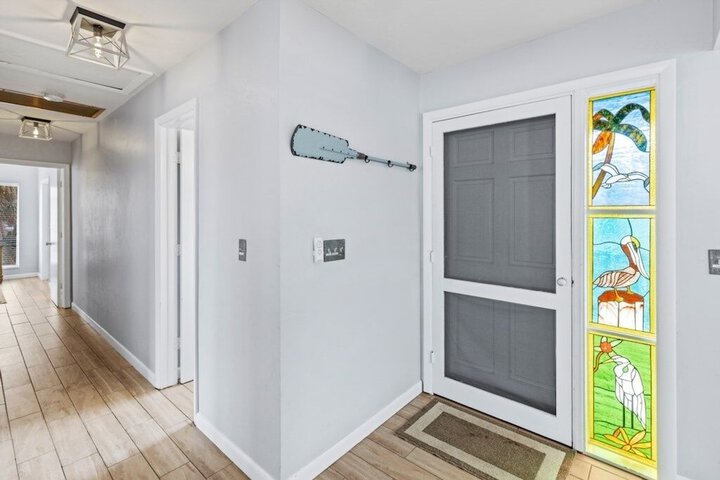



When choosing a stay, check its location, parking, kitchen, laundry, and distance from your planned stops.
Frequently Asked Questions
Seven days is a good starting point for a Florida road trip itinerary if you want to explore one coast without rushing. Three days works for a smaller regional trip, while 10 to 14 days gives you enough time to combine the Gulf Coast, Atlantic Coast, Miami, and the Florida Keys.
November through April is generally a good period for a Florida road trip, with cooler weather across much of the state. The Gulf Coast can also work well from October through May. Check local weather and seasonal events before booking, as conditions and prices vary by region.
Choose the East Coast if you want major cities, historic St. Augustine, Atlantic beaches, and a more direct north-south route. Choose the Gulf Coast for calmer beaches, sunsets, and family-oriented coastal stops. With 10 or more days, you can combine both coasts in one trip.
A Florida road trip can cost anywhere from a few hundred dollars for a short budget trip to several thousand dollars for a longer family vacation. Your biggest expenses are usually lodging, food, gas, and attractions. Vacation rentals, shared accommodation, and free outdoor activities can help reduce the total.
For a Florida road trip with kids, choose a route with shorter driving sections and fewer hotel changes. St. Augustine, Orlando, Tampa, St. Petersburg, Sarasota, and Fort Myers are practical choices. Give yourself at least two nights in key destinations so children have time to settle between drives.
Yes. For a trip of three to six days, focus on one region rather than trying to cross the entire state. The Jacksonville to St. Augustine to Daytona Beach route works well for a short Atlantic Coast trip, while Tampa, Sarasota, and nearby Gulf Coast destinations suit a shorter west-coast itinerary.
A rental car is useful if your itinerary includes multiple Florida cities or coastal destinations. Public transportation and rideshares can work in larger cities such as Miami and Orlando, but they become less practical for a multi-stop road trip. Compare rental, parking, fuel, and rideshare costs before deciding.
More Related Blogs From Travel Recommendations

Vacation Rentals in the Florida Keys


Things to Do in Mid Beach Miami

Margaret C. Jones
Margaret C. Jones, a passionate explorer of North America, captivates readers with her vivid tales on Travelarii’s blog. With a keen eye for hidden gems and local culture, Margaret offers expert advice and unique insights to enhance your travel experience. Her stories bring the diverse landscapes and vibrant cities of North America to life, inspiring readers to embark on their own adventures.