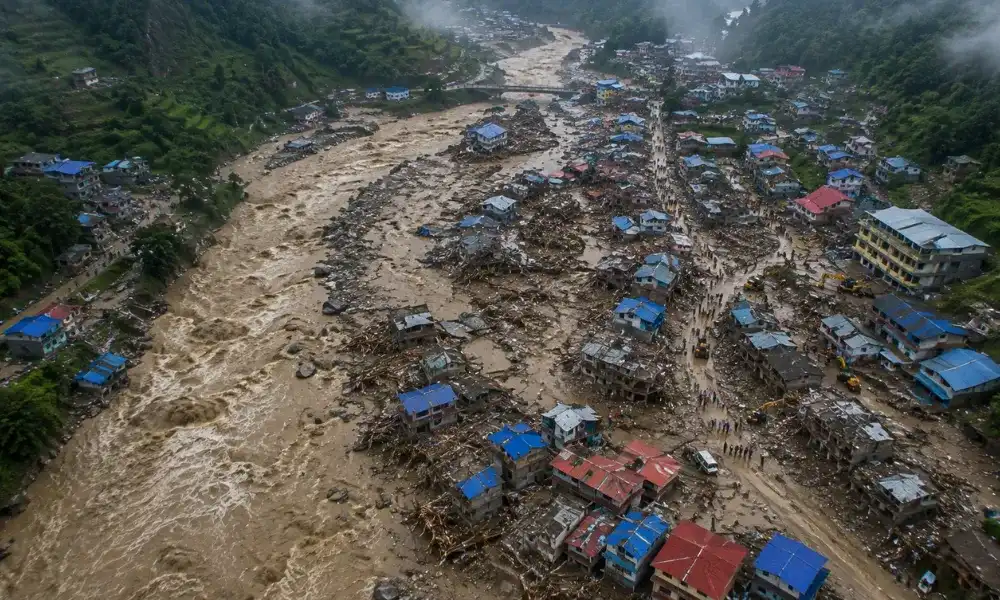
In the space of about a minute on Wednesday morning, a glacial collapse high above the Nepal-Tibet border triggered a catastrophic flash flood in Nepal, sending a wall of ice, rock, and debris crashing down into the Lende Khola tributary and feeding into the Bhote Koshi and Trishuli rivers below.
What began as a routine monsoon morning in Nepal’s Rasuwa and Nuwakot districts turned into one of the most severe disasters the region has seen in decades, with almost no warning before the floodwaters hit.
Find the Right Vacation Rental
Traveling with family, friends, or as a couple? Compare verified rentals that fit your budget and travel style. Choose a place that feels right before you book.
The destruction was near-instantaneous. Entire riverside settlements were swept away, along with critical infrastructure – bridges, roads, and at least six major hydropower and transmission facilities, including the Rasuwagadhi, Chilime, and Trishuli hydropower stations.
Communities in Syapru Besi, Timure, Betrawati, and Trishuli Bazaar bore the brunt of the impact, and the damage has continued to ripple downstream toward Dhading, Gorkha, and Chitwan in the hours since.
Nepal’s National Disaster Risk Reduction and Management Authority says satellite imagery points to an ice and rock avalanche that dammed the Lhende Khola, a small tributary of the Bhote Koshi, before the blockage failed and released the flood downstream.
Nepal’s Foreign Ministry initially attributed the event to an earthquake, but seismic and satellite analysis later ruled that out in favor of the glacial collapse explanation. There was no heavy rainfall in the area beforehand, which is what distinguishes this flood from the monsoon-driven floods and landslides Nepal typically plans for each year.
This is not the first time this stretch of river has flooded. In July 2025, a supraglacial lake burst roughly 35 kilometers upstream in Tibet, destroying the Nepal-China Friendship Bridge and killing nine people.
Reported figures differ across sources and are changing by the hour:
Nepal police have confirmed at least 160 to 175 deaths, according to CBS News and NBC News reporting on August 27.
Nepal’s Tourism Board has put the number of people out of contact anywhere from roughly 384 to more than 1,300, depending on the source and time of reporting (CNN, ABC News, Outlook India).
Chinese state media reported at least 3 deaths and roughly 558 people missing after a related mudslide at the Gyirong border crossing in Tibet, including foreign nationals. Chinese and Nepali officials have not yet confirmed whether any of these figures overlap.
Among those unaccounted for on the Nepal side are dozens of security personnel, including members of the Nepal Army, Nepal Police, and Armed Police Force stationed in the region.
Because communication and power lines across the disaster zone remain down, these numbers should be treated as provisional. Readers who need the most current figures should check Nepal’s Tourism Board or a live wire-service tracker rather than relying on any single fixed number, including the ones above.
Tourist Casualty & Missing Details (According to Country)
India: At least 133 missing foreign nationals were from India on pilgrimage to Mount Kailash in Tibet.
United States: At least 47 people from the US are among the missing.
South Korea: Eight South Korean nationals working on a hydropower plant were reported missing.
United Kingdom: 12 British nationals were among the missing.
Others reported missing include nationals from Australia, Malaysia, the Netherlands, Portugal, and South Africa.
Tibet side: China reported three killed and “major casualties” in Tibet’s Gyirong county.
Tourist Impact & Kailash Mansarovar Pilgrims
Foreign Travelers Trapped. International tourists make up a striking share of those unaccounted for after the flash flood in Nepal. Nepal’s Tourism Board and embassy sources report that more than 470 foreign nationals, spanning roughly 28 countries, remain unaccounted for. The list includes tourists from the United States, Ukraine, Australia, the United Kingdom, Malaysia, Canada, South Africa, and the Netherlands, reflecting how popular this border corridor is with international trekkers and pilgrims, even outside peak trekking season.
Indian Pilgrims at Risk. India has been hit hardest of any single nation, with more than 130 Indian nationals and NRIs reported unaccounted for, many of them pilgrims on the Kailash Mansarovar Yatra route near the Gyirong border crossing. One nonprofit organization alone, the Isha Foundation, reported 77 of its members unaccounted for from an immigration checkpoint, with around 50 believed to be pilgrims on the Yatra. The timing is significant – this pilgrimage season had only recently resumed after years of disruption from the pandemic and India-China tensions, drawing a larger-than-usual number of travelers through the corridor this year.
Downstream Threat & High Alert in India
Border Warning Systems – The rivers behind the flash flood in Nepal don’t stop at the country’s borders – the Bhote Koshi and Trishuli feed into the Gandak River system, which flows directly into India. India’s Central Water Commission has warned that a flood wave of up to three metres could move downstream into the Gandak, turning a Nepal-based disaster into a cross-border monitoring effort almost overnight.
Indian State Mobilization – Bihar’s Disaster Management Department has placed 13 districts on high alert, including West and East Champaran, Gopalganj, Saran, Muzaffarpur, Sitamarhi, Sheohar, and Vaishali, with evacuation orders issued for low-lying areas along the river. Uttar Pradesh’s Chief Minister has separately directed officials in Maharajganj and Kushinagar to prepare for potential emergency response. Along with National Disaster Response Force units, Indian border security personnel are actively monitoring water levels as the situation develops.
Travel Advisory & Emergency Contacts
Travel Warning
Halt all trekking, border-crossing trips, and travel toward Rasuwa, Nuwakot, and Dhading immediately
Rasuwa Gadhi border crossing and the Kailash Mansarovar pilgrimage route are effectively closed for now
Travelers already in northern Nepal should follow local evacuation guidance rather than attempt to pass through affected areas
Kathmandu, Pokhara, and the main Everest and Annapurna trekking regions remain outside the disaster zone
Expect some disruption to domestic transport as resources shift toward relief work
Emergency Assistance Directory
Nepal Tourism Board toll-free emergency number – 1234
Nepal Tourism Board hotline – 1144
Nepal Tourist Police – 9851289445
Embassy of India, Kathmandu – +977 985 131 6807 / +977 970 910 7500 (also reachable via WhatsApp)
U.S. Embassy Kathmandu – +977 (1) 423-4000
Other nationalities – contact your nearest embassy or consulate in Kathmandu directly, and register with your government’s traveler safety program (e.g., U.S. STEP) if not already enrolled
This remains a fast-moving situation. Updates will follow as the confirmed toll, unaccounted-for count, and downstream flood risk in India develop further.