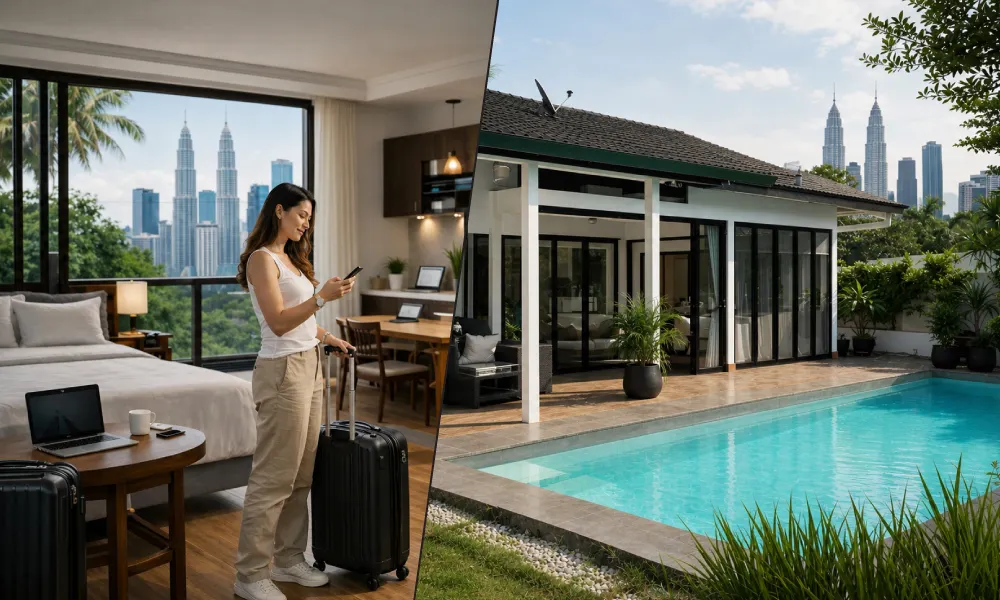
The terms serviced apartment and short-term rental often appear side by side on booking websites, making it easy to assume they mean the same thing. In Malaysia, they don’t. The distinction affects pricing, available services, booking flexibility, and even the type of property you can legally stay in.
In simple terms, a serviced apartment is a professionally managed accommodation with hotel-style services, while a short-term rental is a privately owned property rented for a limited period, often with fewer built-in services.
Find the Right Vacation Rental
Traveling with family, friends, or as a couple? Compare verified rentals that fit your budget and travel style. Choose a place that feels right before you book.
That difference matters depending on why you’re staying in Malaysia. A tourist on a week-long holiday, a remote worker spending two months in Kuala Lumpur, and an expat relocating for a new job will each have different priorities.
This guide explains how serviced apartments and short-term rentals compare across cost, convenience, amenities, flexibility, and day-to-day living, helping you choose the option that fits your stay rather than relying on the label alone.
| Worldwide Most Popular Travel Destinations |
|---|
Table of Content
- What's the Difference Between a Serviced Apartment and a Short-Term Rental?
- How We Compared These Options
- Cost Comparison: Serviced Apartment vs Short-Term Rental in KL
- Which One Is Better for Tourists?
- Which One Is Better for Remote Workers and Digital Nomads?
- Which One Is Better for Expats Settling In?
- Legal and Regulatory Notes for Malaysia
- Final Verdict: Which Should You Book?
- More Related Blogs From Travel Recommendations
What's the Difference Between a Serviced Apartment and a Short-Term Rental?
A serviced apartment in Malaysia is a professionally managed accommodation that operates much like a hotel. These properties are typically run by hospitality companies or licensed operators and usually include services such as a staffed reception, regular housekeeping, security, maintenance, and, in many cases, access to facilities like a gym or swimming pool. Guests can book them for anything from a single night to several months.
A short-term rental, on the other hand, is generally an individually owned apartment, condominium, or house rented for a limited stay through booking platforms or property managers. While some are professionally managed, the guest experience depends on the host. One property may offer self check-in and a fully equipped kitchen, while another provides only the essentials.
The distinction becomes especially important in Malaysia because short-term rental regulations differ between buildings, local authorities, and management corporations. Serviced apartments generally operate under clearer hospitality rules, while short-term rentals offer greater variety in price, layout, and residential feel.
Quick Comparison Table
| Feature | Serviced Apartment | Short-Term Rental |
|---|---|---|
| Managed by | Hotel operator or management company | Individual owner or property manager |
| Daily housekeeping | Usually included | Rarely included |
| Front desk/concierge | Yes | No |
| Kitchen | Sometimes (kitchenette) | Usually full kitchen |
| Lease flexibility | Nightly to monthly | Nightly to monthly (varies by host) |
| Regulatory clarity | High (hotel-licensed) | Varies (STR regulation is still evolving in Malaysia) |
How We Compared These Options
This comparison is based on accommodation listings and property features across Malaysia’s three busiest short-stay markets: Kuala Lumpur, Penang, and Johor Bahru. We reviewed serviced apartments and short-term rentals available for nightly, weekly, and monthly stays, comparing pricing, included amenities, workspace suitability, cancellation flexibility, guest services, and location.
The assessment reflects typical booking patterns and publicly available listings reviewed during 2025 and early 2026. Rather than relying on a single platform or property, the goal is to highlight the differences travelers are most likely to encounter across the Malaysian accommodation market.
Cost Comparison: Serviced Apartment vs Short-Term Rental in KL
Price is often the deciding factor in the short-term rental vs serviced apartment KL debate, but the answer depends on how long you plan to stay. For stays of just a few nights, serviced apartments generally cost more because the rate includes hotel-style services such as housekeeping, reception staff, and on-site support. Short-term rentals usually come in at a lower nightly price, especially when booked directly or through accommodation platforms.
-
Kuala Lumpur
Kuala Lumpur Apartment at Times Square★ 3.5(51) Check priceView Property -
Kuala Lumpur
Abz Apartment at Solstice★ 3.5(263) Check priceView Property -
Kuala Lumpur
Zen66 at Roxy Serviced Apartment★ 3.5(119) Check priceView Property -
Kuala Lumpur
Verve Suite KL Designer Apt by Beestay★ 2.0(1) Check priceView Property -
Kuala Lumpur
Sky Suites at KLCC Kuala Lumpur★ 2.4(5) $253.19/nightView Property -
Kuala Lumpur
Vortex Suites KLCC by Luna★ 1.7(3) $594.49/nightView Property -
Kuala Lumpur
Kuala Lumpur Apartment at Times Square★ 3.5(51) Check priceView Property -
Kuala Lumpur
Abz Apartment at Solstice★ 3.5(263) Check priceView Property -
Kuala Lumpur
Zen66 at Roxy Serviced Apartment★ 3.5(119) Check priceView Property -
Kuala Lumpur
Verve Suite KL Designer Apt by Beestay★ 2.0(1) Check priceView Property -
Kuala Lumpur
Sky Suites at KLCC Kuala Lumpur★ 2.4(5) $253.19/nightView Property -
Kuala Lumpur
Vortex Suites KLCC by Luna★ 1.7(3) $594.49/nightView Property
The gap narrows as the stay gets longer. Weekly discounts are common for short-term rentals, and monthly rates can be substantially lower than paying a nightly hotel-style rate. This is one reason many remote workers and professionals searching for Malaysia expat accommodation prefer furnished short-term rentals for one to three months.
That said, cost should be viewed alongside convenience. Paying slightly more for a serviced apartment may reduce additional expenses if you value regular cleaning, staffed assistance, or included utilities. The lower headline price of a short-term rental can become less attractive if separate charges apply during an extended stay.
Nightly Rate Comparison
| Stay Type | Serviced Apartment (avg/night, RM) | Short-Term Rental (avg/night, RM) |
|---|---|---|
| 1–3 nights | RM 280–500 | RM 180–350 |
| 4–14 nights | RM 240–420 | RM 150–300 |
| 30+ nights (monthly rate) | RM 5,000–8,500/month | RM 3,200–6,500/month |
Average ranges vary by neighbourhood, property size, building age, season, and included services.
What's Included vs What Costs Extra
A serviced apartment in Malaysia typically bundles high-speed Wi-Fi, utilities, routine housekeeping, and access to shared facilities into the advertised rate. Parking may be complimentary at some properties or available for a fixed daily fee.
Short-term rentals usually include Wi-Fi and basic utilities, but cleaning is often limited to before check-in and after check-out unless extra visits are requested for an additional charge. Monthly stays may also have fair-use limits on electricity or separate parking fees, so checking the listing details before booking helps avoid unexpected costs.
Which One Is Better for Tourists?
For holidays lasting just a few days, a serviced apartment in Malaysia is often the more practical choice. Check-in is usually straightforward, a front desk is available if plans change, and regular housekeeping means less time spent dealing with day-to-day chores. Business travelers extending a work trip by a weekend also tend to appreciate the predictable service and hotel-style support.
The equation changes as the trip gets longer or the group gets larger. Families, groups of friends, and travelers staying for a week or more often find better value in a short-term rental. A full kitchen, separate bedrooms, laundry facilities, and additional living space can make longer stays more comfortable while helping reduce food and laundry costs.
For trips of one to four nights, reliability and convenience generally make serviced apartments the stronger option, even if the nightly rate is higher. Once the stay extends beyond that, or multiple people are sharing the accommodation, short-term rentals often provide more space per ringgit and a setup that feels closer to living in a local apartment than checking into a hotel.
Which One Is Better for Remote Workers and Digital Nomads?
For people working while living in Malaysia, accommodation needs extend beyond a comfortable bed. Stable Wi-Fi, a practical workspace, access to cafés, grocery stores, and public transport often matter more than daily housekeeping or concierge services.
This is where short-term rentals usually have the advantage. Many apartments are located in residential neighbourhoods across Kuala Lumpur and Penang, giving remote workers access to local cafés, coworking spaces, fitness centres, and everyday amenities. Monthly pricing is also more competitive, making longer stays easier to budget. A full kitchen and laundry facilities further reduce living costs over several weeks.
Serviced apartments remain a solid option for professionals whose employer covers accommodation or for those staying only a few weeks and prioritising convenience. Reliable maintenance, staffed reception, and included utilities remove much of the day-to-day administration that comes with renting a private unit.
For most month-long stays, however, Malaysia expat accommodation and digital nomad searches increasingly favour well-managed short-term rentals. They offer greater flexibility in neighbourhood choice, more living space, and a residential environment that better suits people balancing work with everyday life, particularly in areas such as Mont Kiara, Bangsar South, KLCC, George Town, and Tanjung Tokong.
Which One Is Better for Expats Settling In?
For many newcomers, Malaysia expat accommodation is a temporary solution rather than a permanent home. The first few weeks are often spent viewing neighbourhoods, opening bank accounts, arranging transport, and deciding where to sign a long-term lease. During this transition, both serviced apartments and short-term rentals serve different purposes.
A serviced apartment in Malaysia is the easiest option for anyone who wants a fully operational home from day one. Utilities are usually connected, furniture is already in place, housekeeping is available, and maintenance issues are handled by on-site staff. This makes serviced apartments particularly appealing for corporate relocations, MM2H participants arriving from overseas, or professionals whose employers are covering accommodation during the relocation process.
Short-term rentals become more attractive once the stay stretches beyond a few weeks. Many offer larger living areas, full kitchens, and residential settings at a lower monthly cost. Living in a local neighbourhood also gives expats a better sense of commuting times, nearby supermarkets, cafés, and community facilities before committing to a year-long lease. For stays lasting one to three months, a well-managed short-term rental often strikes a better balance between flexibility and affordability.
The right choice depends on where you are in the relocation process. If convenience and immediate move-in readiness are the priority, serviced apartments are difficult to beat. If your goal is to explore different areas while keeping housing costs under control, a furnished short-term rental is often the more practical option.
What Expats Should Check Before Booking Either
- Confirm the minimum stay requirement, as some properties accept only weekly or monthly bookings.
- Read the deposit, cancellation, and refund policy carefully before confirming a reservation.
- Check commuting time to your office, international school, or public transport rather than relying only on distance.
- Verify whether the property can provide any documentation needed for visa, employment, or temporary address registration, if applicable.
- Review what is included in the rate, particularly utilities, internet, parking, and cleaning services for longer stays.
- Ensure the apartment is fully furnished if you intend to move in immediately without purchasing household essentials.
Legal and Regulatory Notes for Malaysia
Accommodation rules for short-term rentals are not identical across Malaysia. Requirements can vary by state, local council, and even individual residential developments. In some Kuala Lumpur condominiums, for example, management bodies may restrict or prohibit short-term rentals despite the property being listed online. As a result, the availability of a unit can depend on both local regulations and building-specific rules.
By comparison, a serviced apartment in Malaysia that operates under hotel or hospitality licensing generally follows a clearer regulatory framework for short-stay guests.
Regulations can change over time, so this article should not be treated as legal advice. Before booking, confirm that the property is accepting short-term guests, review the house rules, and verify any stay requirements directly with the host, property manager, or booking platform.
Final Verdict: Which Should You Book?
The better option depends on how you plan to use the accommodation. Tourists staying a few nights and business travelers with packed schedules will usually appreciate the consistency and hotel-style support of a serviced apartment in Malaysia. Remote workers, digital nomads, and expats spending several weeks or months often get better value from a well-managed short-term rental, especially when space, a full kitchen, and neighbourhood choice matter.
If you’re comparing options for an extended stay, browse Travelarii’s monthly-friendly Kuala Lumpur rentals to find furnished properties suited to remote work and relocation. Planning a shorter visit instead? Explore Travelarii’s short-term stays across Malaysia to compare apartments that match your travel dates, budget, and preferred location.