
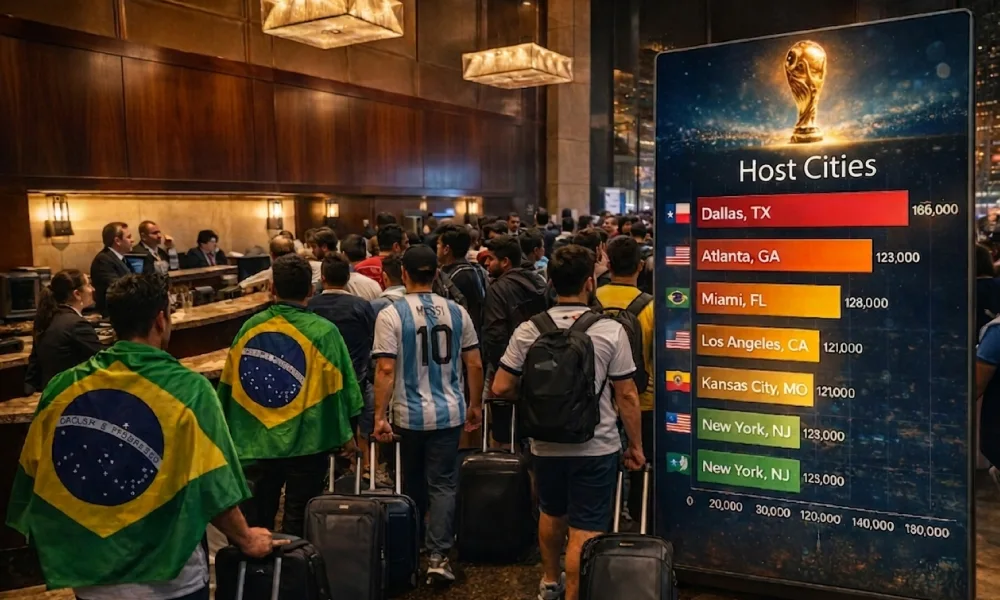
Talk to anyone who has tried to book a hotel in a World Cup 2026 host city recently. They will tell you the same thing. The rooms are gone, the prices are unrecognizable, and the options that remain are not the ones anyone planned on.

This is the reality behind the biggest FIFA World Cup in history. June 11, 2026, forty-eight nations, 104 matches, 16 cities across the United States, Canada, and Mexico, and an estimated 6.5 million fans all reaching for the same limited pool of accommodation at once.
The FIFA World Cup 2026 accommodation shortage is already in motion. This guide cuts through the noise. We analyze every host city’s hotel inventory, price surge data, and real risk level so you can make smart decisions about where to stay for World Cup 2026 before it is too late.
| Book Hotels Near FIFA WC ’26 Stadiums |
|---|
A May 2026 American Hotel and Lodging Association survey puts 80% of hoteliers below their booking projections, which sounds like good news until you look closer. Room shortages have already taken hold in a number of host cities, while others still have workable inventory left, and that gap matters enormously depending on where your matches actually fall.
Table of Content
Why This World Cup Is Different
Every World Cup before this one concentrated visitors into a single country. Qatar 2022 handled its hotel shortage through cruise ships and purpose-built fan compounds. Brazil 2014 had a continent-sized country absorbing the load. This edition works differently, with three host nations and 16 cities spread across nearly 5,000 miles.
Spreading the tournament across North America does not distribute the pressure evenly. Instead, it creates localized pressure points in specific cities.
Vancouver and Kansas City are absorbing demand at a scale their hotel infrastructure was never built to handle, while New York and Los Angeles, though better stocked with rooms, have priced their inventory into a bracket that shuts out most fans who did not book months ago.

Vancouver makes the gap especially clear. BC Place holds 54,500 fans, yet the city carries roughly 22,700 hotel rooms, rising to about 41,800 across the wider metro area once short-term rentals are factored in.
With seven matches scheduled, a Deloitte report commissioned by Airbnb calculated a shortfall of 70,000 accommodation nights across the tournament window, a figure the report itself describes as unfilled under current regulations.
We’re not going to be able to fulfill demand, and that’s hugely concerning.— Sarah Kirby-Yung, Vancouver City Councillor
For fans still sorting out where to stay, the most practical answer in the tightest markets is verified vacation rentals. Travelarii has properties listed near every host stadium across all 16 cities, with confirmed availability and transparent pricing, which is something standard hotel booking sites can no longer consistently offer in the cities facing the worst shortages.
The Cities at Highest Risk
Not every host city faces the same pressure. Here is an honest, data-driven assessment of where the World Cup 2026 accommodation by host city situation is most dire, and where fans still have a fighting chance of finding a room.
All 16 Host Cities, Ranked by Accommodation Pressure
The table below uses hotel price surge data from Lighthouse Intelligence and The Athletic. Every city links directly to Travelarii’s verified rental inventory for that venue.
| # | City | Price Surge | Risk Level | Book on Travelarii |
|---|---|---|---|---|
| 1 |
Mexico City
🇲🇽 Mexico
|
+961% | Critical | Find Stays → |
| 2 |
Monterrey
🇲🇽 Mexico
|
+466% | Critical | Find Stays → |
| 3 |
Houston
🇺🇸 USA
|
+457% | High | Find Stays → |
| 4 |
Guadalajara
🇲🇽 Mexico
|
+405% | Critical | Find Stays → |
| 5 |
Kansas City
🇺🇸 USA
|
+364% | High | Find Stays → |
| 6 |
Atlanta
🇺🇸 USA
|
+344% | High | Find Stays → |
| 7 |
San Francisco
🇺🇸 USA
|
+342% | High | Find Stays → |
| 8 |
Miami
🇺🇸 USA
|
+275% | High | Find Stays → |
| 9 |
Seattle
🇺🇸 USA
|
+261% | High | Find Stays → |
| 10 |
Boston
🇺🇸 USA
|
+261% | High | Find Stays → |
| 11 |
Vancouver
🇨🇦 Canada
|
+233% | Critical | Find Stays → |
| 12 |
New York / NJ
🇺🇸 USA
|
+228% | High | Find Stays → |
| 13 |
Los Angeles
🇺🇸 USA
|
+211% | Moderate | Find Stays → |
| 14 |
Philadelphia
🇺🇸 USA
|
+198% | Moderate | Find Stays → |
| 15 |
Dallas
🇺🇸 USA
|
+174% | Best Value | Find Stays → |
| 16 |
Toronto
🇨🇦 Canada
|
+78% | Best Value | Find Stays → |
Price surge data: Lighthouse Intelligence and The Athletic, 2025–2026.
Where to Stay for World Cup 2026: City-by-City Overflow Strategies
If You're Going to Vancouver
The city is actively pursuing alternative accommodation: fan villages using Simon Fraser University dormitories (from ~$250/night), floating hotel proposals, and relaxed short-term rental regulations.
Several new hotels opened or are opening in Burnaby and Surrey in time for the tournament, including a new Hyatt Place in Metrotown. If you cannot secure downtown Vancouver, consider Richmond or Burnaby, both of which are connected by SkyTrain directly to the stadium.
If You're Going to Mexican Host Cities
Short-term rentals are your best bet for value. Airbnb has announced a $5 million investment program and is actively recruiting new hosts in neighborhoods beyond the typical tourist zones.
In Mexico City, neighborhoods like Iztacalco and Venustiano Carranza, close to transit links but outside the premium hotel corridors, are emerging as value hubs. Book through official FIFA accommodation portals where available, as some blocks are held at regulated rates.
If You're Going to the Final (New York/New Jersey)
MetLife Stadium hosts the World Cup Final on July 19. A stay at a Hampton Inn in Carlstadt, New Jersey, is already listed at $3,518 per night for the final weekend.
The New York metro’s enormous hotel infrastructure spanning New Jersey, Connecticut, and Long Island gives it more overflow capacity than any other host city, but “more capacity” still means eye-watering prices for a global final. Book New Jersey over Manhattan for better access and marginally better value.
The Best-Value Host Cities Right Now
Toronto and Dallas stand out as the least pressured markets. Toronto’s price surge of just 78% is the lowest of any host city, a function of its large hotel stock and the fact that domestic Canadian demand is spread more efficiently across the country.
Either way, it is worth understanding the gap between hotel and rental costs in World Cup host cities before committing, since rentals in both markets regularly undercut hotel rates once your group size goes beyond two.
The Verdict: Which Cities Will Run Out of Rooms First?
Vancouver will run dry first. A 70,000-night structural shortfall, strict short-term rental rules, and a compact downtown hotel market mean that once fan bookings accelerate in the final weeks, there will be no slack left in the system. The Deloitte report does not hedge: the gap is unfillable under current city policy. Act now if Vancouver is on your schedule.
Guadalajara and Monterrey have already run out of affordable hotel rooms. The 333% and 218% year-on-year price increases have removed most of the hotel market from the practical reach of ordinary fans. Vacation rentals are what is left, and they are currently the better option in terms of both availability and price per person for groups.
Kansas City is the one to watch among US cities. Current bookings are running below a normal summer, but that low number reflects deferred decisions, not low demand. The Metro Hotel stock is too thin to handle a late rush. Fans who assume they have time in Kansas City are taking a risk that the data does not support.
The cities least likely to “run out”: New York/New Jersey, Los Angeles, Toronto, and Dallas. These markets have either the inventory depth or the infrastructure spread to absorb demand, though “not running out” still means paying dramatically more than you’d expect.
Closure
The FIFA World Cup 2026 accommodation shortage is real, it is uneven, and it is moving fast. The good news: FIFA’s room release has briefly reopened inventory that was locked away for months. The bad news: that window is closing, prices are not dropping with it, and three to four host cities face a shortfall that no amount of booking strategy can fully solve. Act now or plan your overflow city carefully.
FAQs
Yes, but unevenly distributed. Cities like Vancouver face a documented 70,000-night shortfall that experts call unfillable. Mexican host cities have inventory, but at prices that represent 200–960% increases over normal rates. Several US cities, such as Kansas City, Boston, and Atlanta, face limited supply relative to expected demand. Toronto and Dallas remain the most accessible markets.
Industry analysts say no for the cities most at risk. While FIFA’s room block release added supply to the market in late March and April 2026, hotel operators have shown no intention of lowering prices in response. Occupancy in cities like Vancouver is projected at 90%, regardless there is no pricing pressure forcing rates down.
For the tournament, which runs June 11 – July 19, 2026, it is urgent but not too late for most cities. The FIFA room release in March/April 2026 returned significant inventory to the market. However, Vancouver, Mexican host cities, and cities hosting semifinal and final matches (MetLife/New York) are the tightest. Act immediately for those destinations. Dallas, Toronto, and Philadelphia still have manageable availability.
More Related Blogs From Tips & tricks




Margaret C. Jones
Margaret C. Jones, a passionate explorer of North America, captivates readers with her vivid tales on Travelarii’s blog. With a keen eye for hidden gems and local culture, Margaret offers expert advice and unique insights to enhance your travel experience. Her stories bring the diverse landscapes and vibrant cities of North America to life, inspiring readers to embark on their own adventures.