
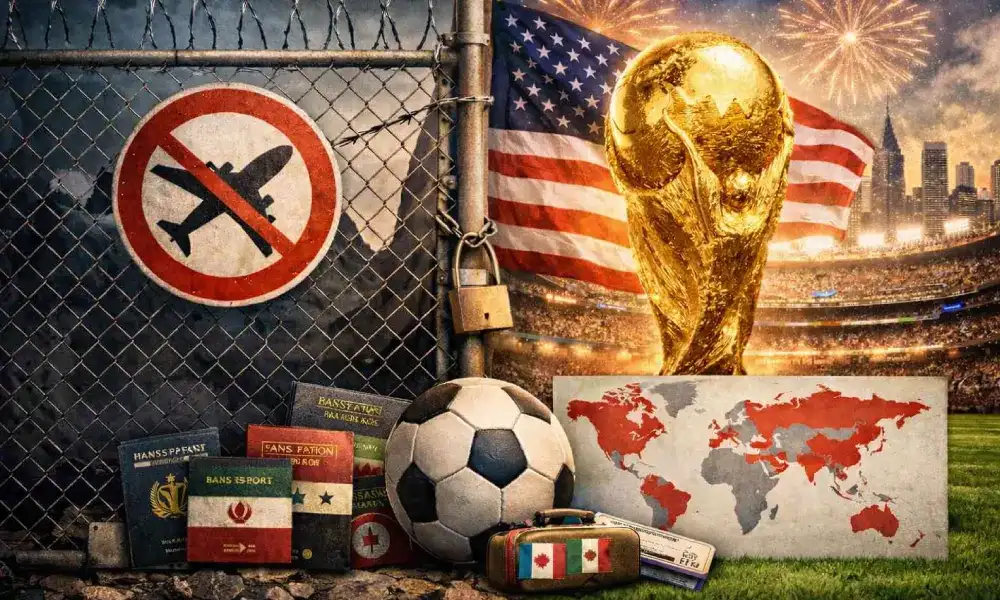
The travel ban countries for FIFA World Cup 2026 include 39 nations under U.S. visa restrictions. Of these, 19 face a full B-1/B-2 visitor visa suspension and 20 face partial restrictions.

Four qualified World Cup teams are directly affected – Haiti, Iran, Ivory Coast, and Senegal. Players and coaches from these nations can still enter the U.S. to compete, but regular fans cannot obtain the tourist visas needed to attend U.S.-hosted matches.
This guide gives you the complete, up-to-date list of travel ban countries for FIFA World Cup 2026, explains what the bans mean, and outlines what options affected fans still have.
| Book Hotels Near FIFA WC ’26 Stadiums |
|---|
Table of Content
- How the U.S. Travel Bans Work
- Full List of Travel Ban Countries for FIFA World Cup 2026
- The 4 Qualified World Cup Teams Directly Affected
- Countries Facing Visa Bond Requirements
- Countries Facing Extended Visa Processing Delays
- Who Is Exempt from the Travel Bans
- Options for Fans from Banned Countries
- FAQs
- More Related Blogs From Travel Recommendations
How the U.S. Travel Bans Work
The restrictions come from two presidential proclamations. The first, signed on June 4, 2025, placed 19 countries under full visa suspension. The second, signed on December 16, 2025 and taking full effect on January 1, 2026, expanded that list to 39 countries. The key visa type affected is the B-1/B-2 visitor visa, which is the standard tourist visa most international fans need to attend matches on U.S. soil.
The proclaimed reasons include deficiencies in those countries’ security screening practices, high visa overstay rates, and refusal to accept deportees. The bans cover roughly 20 percent of all United Nations-recognized countries.
Having a FIFA World Cup 2026 ticket does not guarantee entry into the United States. Visa bans apply regardless of ticket status, and even a valid ticket cannot override a travel restriction. Fans from non-banned countries should still apply for visas well in advance, as processing times have lengthened significantly.
It is equally important for all international visitors to understand the ICE immigration laws for international visitors attending the tournament, as enforcement at and around U.S. venues carries its own set of considerations that go beyond the visa application process.
Full List of Travel Ban Countries for FIFA World Cup 2026
Below is the complete breakdown of all 39 countries facing U.S. visa restrictions as of May 2026, organized by the level of restriction in place.
Countries with Full B-1/B-2 Visa Suspension (19 Nations)
Citizens of these countries cannot obtain a B-1/B-2 tourist visa under any circumstances, unless they hold dual nationality with a non-restricted country or already had a valid visa issued before the ban dates.
| Country | Region | Restriction Level | World Cup Qualified |
|---|---|---|---|
| Afghanistan | Asia | FULL BAN | No |
| Burkina Faso | West Africa | FULL BAN | No |
| Burma (Myanmar) | Asia | FULL BAN | No |
| Chad | Central Africa | FULL BAN | No |
| Republic of the Congo | Central Africa | FULL BAN | No |
| Equatorial Guinea | Central Africa | FULL BAN | No |
| Eritrea | East Africa | FULL BAN | No |
| Haiti | Caribbean | FULL BAN | Yes |
| Iran IR | Middle East | FULL BAN | Yes |
| Laos | Asia | FULL BAN | No |
| Libya | North Africa | FULL BAN | No |
| Mali | West Africa | FULL BAN | No |
| Niger | West Africa | FULL BAN | No |
| Sierra Leone | West Africa | FULL BAN | No |
| Somalia | East Africa | FULL BAN | No |
| South Sudan | East Africa | FULL BAN | No |
| Sudan | East Africa | FULL BAN | No |
| Syria | Middle East | FULL BAN | No |
| Yemen | Middle East | FULL BAN | No |
The suspension also applies to individuals holding travel documents issued by the Palestinian Authority, even if those documents are issued by a non-listed entity.

Countries with Partial B-1/B-2 Visa Restrictions (20 Nations)
Citizens of these countries face a partial suspension of B-1/B-2 visitor visa issuance. Visa approvals are severely limited or subject to additional scrutiny and delays. Some nations on this list also face visa bond requirements of up to USD 15,000 per applicant.
| Country | Region | Restriction Level | World Cup Qualified |
|---|---|---|---|
| Algeria | North Africa | PARTIAL | Yes |
| Angola | Southern Africa | PARTIAL | No |
| Belarus | Europe | PARTIAL | No |
| Cabo Verde | West Africa | PARTIAL | Yes |
| Cambodia | Asia | PARTIAL | No |
| Cuba | Caribbean | PARTIAL | No |
| DR Congo | Central Africa | PARTIAL | No |
| Ethiopia | East Africa | PARTIAL | No |
| Gambia | West Africa | PARTIAL | No |
| Guinea | West Africa | PARTIAL | No |
| Ivory Coast | West Africa | PARTIAL | Yes |
| Liberia | West Africa | PARTIAL | No |
| Mauritania | West Africa | PARTIAL | No |
| North Korea | Asia | PARTIAL | No |
| Pakistan | Asia | PARTIAL | No |
| Russia | Europe | PARTIAL | No |
| Senegal | West Africa | PARTIAL | Yes |
| South Africa | Southern Africa | PARTIAL | No |
| Turkmenistan | Central Asia | PARTIAL | No |
| Venezuela | South America | PARTIAL | No |
The 4 Qualified World Cup Teams Directly Affected
Of the 48 nations competing in the 2026 FIFA World Cup, four are under direct U.S. visa restrictions. Their players and coaches are exempt from the ban under a special sporting exemption, but their fans are not.
| Country | Restrictions | Venue Logistics |
|---|---|---|
| Haiti | Full Ban | All group games in U.S. |
| Iran | Full Ban | All group games in U.S. |
| Ivory Coast | Partial Ban | Split schedule (one game in Canada) |
| Senegal | Partial Ban | Games in both U.S. and Canada |
The situation for Iran carries an additional layer of complexity. U.S. Secretary of State Marco Rubio stated that Iranian players who have served in the Islamic Revolutionary Guard Corps may face further individual scrutiny, even within the athletic exemption framework. This creates uncertainty for certain team members beyond what other affected nations face.
Countries Facing Visa Bond Requirements
Beyond the 39 restricted countries, a further group of World Cup-qualified nations was subject to a USD 15,000 visa bond requirement as part of a U.S. pilot program targeting high visa-overstay-rate countries. The five World Cup-qualified countries that were originally subject to visa bonds are Algeria, Cabo Verde, Ivory Coast, Senegal, and Tunisia.
In May 2026, the U.S. State Department announced a waiver of the visa bond for fans who purchased FIFA World Cup tickets and enrolled in the FIFA Priority Appointment Scheduling System (PASS) by April 15, 2026. The waiver removes the financial deposit requirement only. Standard visa screening, interviews, and approval processes still apply in full.
What is FIFA PASS? The FIFA Priority Appointment Scheduling System is a fast-track visa appointment program launched by the U.S. State Department for World Cup ticket holders. It provides quicker access to visa interview slots at U.S. embassies and consulates but does not guarantee a visa and does not override any travel ban.
Countries Facing Extended Visa Processing Delays
Even outside the 39 restricted countries, several high-traffic fan nations are experiencing significant visa processing delays due to increased global demand and tightened U.S. vetting procedures. World Cup-qualified nations affected by delays or additional scrutiny include Algeria, Brazil, Colombia, Egypt, Ghana, Guatemala, Jordan, Morocco, Nigeria, Tunisia, and Uruguay.
Fans from these countries are not banned, but they face longer waiting times for B-1/B-2 visa appointments. Anyone planning to attend matches in the United States is strongly advised to apply for a visa as early as possible, well before the June 11, 2026 opening match.
Who Is Exempt from the Travel Bans
Both the June and December 2025 proclamations include a defined set of exemptions. Understanding who qualifies is essential for affected travelers. Fans who are unsure whether their nationality falls among the visa-free countries for USA travel should verify their status before making any bookings, as those eligible may be able to enter through ESTA without a consular interview altogether.
| Category | Exempt from Ban | Notes |
|---|---|---|
| Players and coaches | Yes | Covers all 48 qualified teams |
| Necessary support staff | Yes | Definition subject to case-by-case review |
| Immediate family of athletes | Yes | Spouses, unmarried children under 21, parents |
| U.S. permanent residents | Yes | Green card holders are unaffected |
| Dual nationals | Potentially | If second passport is from a non-banned country |
| Diplomats | Yes | Standard diplomatic exemption applies |
| Regular fans from banned countries | No | No exemption granted for spectators |
| Journalists from banned countries | No | Press credentials do not override the ban |
| Corporate sponsors from banned countries | No | Business travel not exempted |
Options for Fans from Banned Countries
Fans who cannot obtain U.S. visas still have meaningful ways to experience the 2026 FIFA World Cup, because the tournament spans three countries, and neither Canada nor Mexico has equivalent bans.
Watch Matches in Canada
Canada hosts matches in Toronto and Vancouver. Canada applies its own visa requirements, which are strict but do not include the blanket suspensions present in the U.S. system. Fans from restricted countries should check eligibility for a Canadian visitor visa separately. Ivory Coast, notably, plays one of its group stage games in Toronto, giving its fans a realistic route to attend at least one match.
Watch Matches in Mexico
Mexico hosts matches in Mexico City, Guadalajara, and Monterrey. Mexico does not have a travel ban list equivalent to the U.S. proclamations. Many nationalities that require a U.S. visa can enter Mexico without a visa or obtain a visa on arrival. Fans from banned countries should verify current Mexican entry requirements, which can change independently of U.S. policy.
Dual Citizenship
Fans who hold a valid passport from a non-restricted country, even if they are also nationals of a banned country, may be able to travel to the U.S. using that second passport. This option depends on individual circumstances and the specific terms of a person’s dual nationality.
Pre-Existing Valid Visas
Fans who already hold a valid U.S. B-1/B-2 visa issued before June 9, 2025 (for the original 19 countries) or before January 1, 2026 (for the expanded list of 20 additional countries) may still be able to travel, provided their visa has not been revoked, and they otherwise meet entry requirements.
FAQs
The four qualified teams affected are Haiti, Iran, Ivory Coast, and Senegal.
Yes, players, coaches, and core support staff are exempt from the ban under a special sporting exemption.
The 19 nations under a full U.S. visa suspension are Afghanistan, Burkina Faso, Burma (Myanmar), Chad, Republic of the Congo, Equatorial Guinea, Eritrea, Haiti, Iran, Laos, Libya, Mali, Niger, Sierra Leone, Somalia, South Sudan, Sudan, Syria, and Yemen
Affected fans can attend matches in Canada or Mexico, utilize dual citizenship, or use pre-existing U.S. visas.
No, the FIFA PASS program does not help fans from the 39 restricted nations.
The 20 nations facing partial U.S. tourist visa suspensions include Angola, Antigua and Barbuda, Benin, Burundi, Côte d’Ivoire, Cuba, Dominica, Gabon, The Gambia, Malawi, Mauritania, Nigeria, Senegal, Tanzania, Togo, Tonga, Venezuela, Zambia, and Zimbabwe.
More Related Blogs From Travel Recommendations



Margaret C. Jones
Margaret C. Jones, a passionate explorer of North America, captivates readers with her vivid tales on Travelarii’s blog. With a keen eye for hidden gems and local culture, Margaret offers expert advice and unique insights to enhance your travel experience. Her stories bring the diverse landscapes and vibrant cities of North America to life, inspiring readers to embark on their own adventures.