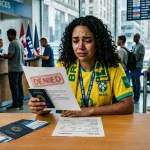

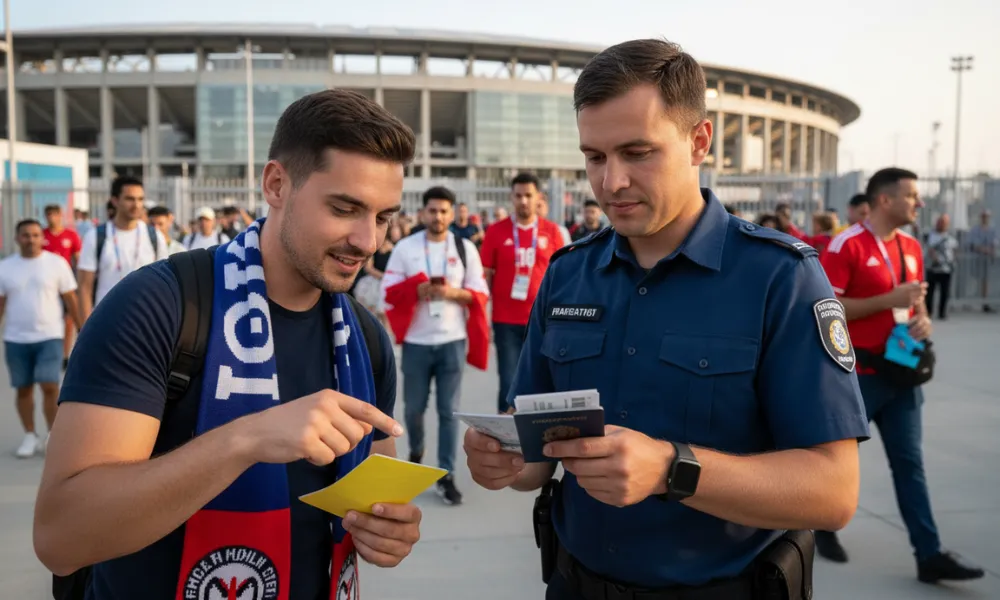
Yes, ICE (U.S. Immigration and Customs Enforcement) officers are expected to have a presence at some FIFA World Cup 2026 venues in the United States. However, the Department of Homeland Security (DHS) has stated that its primary role is venue security, not targeted immigration sweeps.

Legally authorized visitors have been told they have “nothing to worry about.” Still, the situation remains fluid, and fans traveling from outside the U.S. should understand what this means for their trip.
| Book Hotels Near FIFA WC ’26 Stadiums |
|---|
Table of Content
Tournament at a Glance
This is the largest FIFA World Cup in history. Understanding the scale makes it clear why immigration policy decisions carry such high stakes.
| FIFA World Cup 2026 Key Statistics | ||
|---|---|---|
| Category | Projection / Statistic | Details |
| Total Fans Expected | 5M+ | Across all three host nations, per FIFA projections |
| U.S. International Visitors | 1.24M | Projected specifically for U.S. matches |
| U.S. Host Cities | 11 | Including New York, Los Angeles, Miami, Dallas, Seattle |
| Total Matches | 104 | Across 48 teams (78 of these matches will be in the United States) |
What DHS and ICE Have Actually Said
In mid-May 2026, two DHS officials told NBC News that ICE personnel may be present at World Cup matches as part of an offer to provide perimeter security alongside local police departments and federal agencies. The role is described as similar to what ICE has done at the Super Bowl and the Kentucky Derby.
“What makes someone a target for immigration enforcement is whether or not they are illegally in the U.S. -full stop.” – DHS Spokesperson, May 2026
DHS also stated directly that ICE officers working stadium security will not be checking spectators or employees for immigration status.
However, a critical detail has been widely reported: no internal guidance has gone out instructing ICE officers to avoid making immigration arrests at World Cup venues. The two roles, security support and independent enforcement, have not been formally separated.
ICE Acting Director Todd Lyons said in February 2026 that the agency would play a “key part” in World Cup security, framing it similarly to its role at other major U.S. sporting events. DHS Secretary Markwayne Mullin separately stated that ICE agents would not be stationed outside stadiums to “round people up.”
At the same time, the department confirmed it is actively offering ICE personnel to local and federal partners for venue security, though it has not specified which of the 11 U.S. host cities will see an ICE presence.

Why This Matters for International Fans
Understanding the real-world impact of ICE immigration laws on the World Cup 2026 requires examining which countries are sending the most fans. The tournament spans 16 cities across the United States, Canada, and Mexico, and the fan demographics reflect three distinct regions.
The largest expected fan groups traveling into the United States come from Brazil, Argentina, Mexico, England, and Germany, countries with strong football cultures and large diaspora communities already living in U.S. host cities.
Fans from South Korea, Japan, Portugal, France, and the Netherlands are also projected to attend in significant numbers. For the United States itself, domestic fan enthusiasm is high given the home-nation effect.
For Canada, the primary international travelers are expected to be from the United Kingdom, France, Morocco, and Latin America. Mexico will draw large numbers from South America and Central America, with Colombian and Argentinian fans among the most anticipated, given their teams’ strong placement in the draw.
Travel Restrictions Already in Effect
ICE at stadiums is only one part of the picture. Multiple overlapping U.S. entry policies are already in force before any fan reaches a venue gate.
ADDITIONAL WARNINGS FOR ALL TRAVELERS
ICE agents have been deployed to U.S. airports since March 2026, operating alongside Customs and Border Protection
Social media and device searches at the border have increased significantly – back up your data and review your phone’s content before you travel
A proposed rule requiring tourists to submit full social media histories has not yet been finalized-check state.gov for updates before your departure date
DHS raised the possibility of stopping processing of international travelers at airports in “sanctuary cities” at least 6 of the 11 U.S. host cities are considered sanctuary jurisdictions
Your Legal Rights at a World Cup Venue
Regardless of your immigration status, you have legal rights when interacting with law enforcement in the United States. According to legal experts at FindLaw:
- You are not required to answer questions, sign documents, or open the door if you are in a private space and agents do not have a judge-signed warrant.
- If you are a U.S. citizen, you are not legally required to show documents to ICE.
- If you are a non-citizen, you should carry valid proof of your immigration status at all times.
- Never present false documents or claim to be a citizen when you are not.
- No officer, supervisor, or stadium administrator can legally confiscate your passport. If this happens, it may be a sign of labor exploitation or human trafficking. Contact an attorney immediately.
What Legally Admitted Fans Should Do Before They Travel
If you are traveling legally to a U.S. World Cup venue, preparation is your strongest protection:
- Carry your valid passport and all travel authorization documents (ESTA, B-1/B-2 visa, or other relevant documentation) at all times during your trip.
- Download your I-94 travel record from the official CBP website within 24 hours of U.S. arrival and check your “Admit Until” date against your departure flight.
- Keep printed or accessible copies of your match tickets, accommodation bookings, and return flight information.
- Know your consulate or embassy contact information for your home country while in the U.S.
- Review the U.S. State Department’s official FIFA World Cup 2026 travel information page at state.gov/fifa-world-cup-26.
Practical Steps for International Fans
Regardless of where you are traveling from, here are the steps every international fan should complete before arriving in the United States for World Cup 2026.
- Check your country’s entry status.
Before making any commitments, verify whether your nationality falls among the countries affected by the travel ban for FIFA World Cup 2026 or is subject to a visa bond requirement. Visit the U.S. State Department website at state.gov for the most current information.
- Apply for your visa as early as possible.
The FIFA PASS system offers priority consular appointment slots for fans with confirmed tickets. For those still in the application process, checking the latest updates on US visa delays for World Cup 2026 is essential before deciding when and where to book your interview. Wait times have been significant, and leaving this until the last minute is a serious risk.
- Carry all documents at all times during your trip.
Keep your passport, a valid visa, and your match ticket on your person throughout your stay. DHS has specifically asked fans to be proactive about documentation.
- Prepare your devices before you travel.
Back up your phone data. CBP conducted over 55,000 device searches at U.S. borders in FY2025. Be aware of what is stored on your phone before arrival.
- Know your rights.
Review the ACLU’s “Know Your Rights” resources for guidance on interacting with immigration enforcement and law enforcement officials inside the United States.
- Register with your home country’s embassy.
Register with your consulate in the United States before you arrive so they can reach you in an emergency or if you are detained.
- Have an emergency contact plan ready.
Download an app that can immediately notify emergency contacts if you are detained – this was a specific recommendation from the Amnesty International World Cup travel advisory.
Conclusion
While DHS clarifies that ICE personnel will assist local law enforcement with venue perimeter security rather than conducting dedicated immigration sweeps, officers have not been explicitly barred from making arrests.
Because no formal written directives or stadium exclusion zones exist, international travelers from Latin America, Africa, Asia, and Europe need to ensure they have flawless documentation and clear knowledge of their legal rights. Staying updated via the U.S. State Department and FIFA tracking platforms remains the best way to keep the focus entirely on the matches.
FAQs
Yes. DHS officials have stated that ICE personnel may be present at some U.S. World Cup venues to support perimeter security and coordination with local law enforcement.
DHS has stated that ICE officers assigned to venue security will not be checking spectators or employees for immigration status.
Carry your passport, visa or ESTA approval, I-94 record if applicable, match tickets, and travel confirmations.
Check entry rules early, confirm visa requirements, carry documents, know your rights, and monitor official DHS, State Department, and FIFA updates.
DHS stated ICE would support security operations, but exact deployment locations have not been disclosed.
More Related Blogs From Tips & tricks




Margaret C. Jones
Margaret C. Jones, a passionate explorer of North America, captivates readers with her vivid tales on Travelarii’s blog. With a keen eye for hidden gems and local culture, Margaret offers expert advice and unique insights to enhance your travel experience. Her stories bring the diverse landscapes and vibrant cities of North America to life, inspiring readers to embark on their own adventures.