

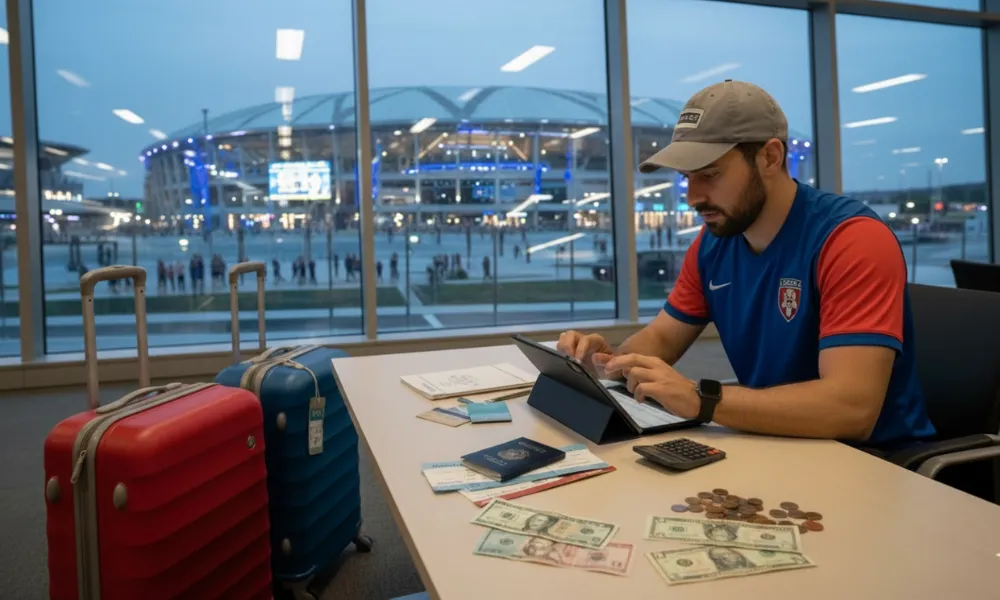
A realistic FIFA World Cup 2026 trip costs approximately $2,400 for a shoestring budget (Mexican host cities, hostel stays), $9,400 for a mid-range experience (3-star US/Mexico hotels, 3 matches), and $15,000–$40,000+ for a premium multi-city journey.

Finding the best rates during high-demand events like this one means moving on flights and accommodation well before the tournament kicks off. But before you spend a single dollar on flights or hotels, you cannot enter any stadium without a free FIFA Fan ID. Most fans don’t know this until it’s too late.
| Book Hotels Near FIFA WC ’26 Stadiums |
|---|
Table of Content
- What Makes the 2026 FIFA World Cup Trip Cost Unlike Any Tournament Before It?
- Step Zero Before Any Budget - The Mandatory FIFA Fan ID
- The Complete Visa and Entry Cost Table by Nationality
- FIFA WC26 Ticket Prices - Face Value vs. What You Will Actually Pay
- Official Hospitality Packages - The Guaranteed Seat Backdoor
- Accommodation Costs - The 31.44% Match-Night Premium and City-by-City Reality
- Flight Costs - The 30–60% Tournament Window Spike
- Daily Living Costs - Food, Stadium Spending, and the Hidden Tax
- Transportation - Bargains, Rip-Offs, and the Uber Surge Problem
- The Complete FIFA World Cup 2026 Budget Summary
- Your Strategic Planning Timeline - Month by Month
- The Cheapest and Most Expensive Cities - A Final Comparison
- The Hidden Costs Most Budget Guides Skip
- Final Verdict - Is the 2026 FIFA World Cup Still the People's Game?
- More Related Blogs From Tips & tricks
What Makes the 2026 FIFA World Cup Trip Cost Unlike Any Tournament Before It?
The 2026 FIFA World Cup breaks records before a single ball is kicked. For the first time in history, it is co-hosted by three countries – the United States, Canada, and Mexico – across 16 cities and 104 matches, running from June 11 to July 19, 2026.
The tournament opens at Estadio Azteca in Mexico City and closes with the Final at MetLife Stadium in New York/New Jersey. But size is only part of the story. What makes the 2026 World Cup trip cost genuinely difficult to plan – and financially painful for the unprepared – is a combination of three forces working simultaneously.
Dynamic pricing means ticket prices shift daily based on demand and match importance, not a fixed price list. Supply stagnation in cities like Vancouver and Boston means hotels with 20 years of limited new room supply are now facing historic demand. And algorithmic price discovery means everything from rideshares to room rates is being set by software optimising for maximum yield, not fan accessibility.
The result? A tournament where attending the same match type – say, a Round of 16 game – can cost you $3,000 in New York or $900 in Houston, simply based on which city you choose. This guide cuts through the noise with real, verified numbers across every cost category.
Step Zero Before Any Budget - The Mandatory FIFA Fan ID
Most fans budget for tickets, hotels, and flights. They forget the one thing that makes all of it worthless without it.
Every ticket holder at all 16 venues must obtain a FIFA Fan ID. This is a free digital identity credential that is completely separate from your match ticket. Stadium security will scan both your ticket QR code and your Fan ID at the turnstile. If the two are not linked before you arrive, you will be refused entry – no exceptions – regardless of whether you paid $60 or $32,000 for your seat.
The Fan ID cannot be obtained at the stadium. It must be processed and approved in advance.
Key Fan ID Facts Every Fan Must Know
It is 100% free. Any website charging a “processing fee,” “fast-track fee,” or “handling fee” for a Fan ID is a scam. Fraudulent sites with names like fifa-fanid.com or fanid2026.com are already active and collecting passport data and money illegally. Only apply through the official FIFA portal accessible via your ticket account.
The 8-Week Rule. Apply at least 8 weeks before your first match. This is the last comfortable deadline to resolve photo rejections or passport mismatches without anxiety. Applying less than 4 weeks out is what experts call the “risk zone” – FIFA does not guarantee rush processing.
Documentation required: A passport-style photo and a clear scan of your passport bio-page, valid through at least January 2027.
The visa silver lining – with an important caveat. For some nationalities (including the UK, Germany, and France), the Fan ID may serve as a temporary visa supplement for entry into the host countries. However, this is not legally finalised for all cases, particularly in Canada. Do not assume the Fan ID is your entry document. Verify your specific situation using FIFA’s official Visa Checker tool before booking any travel.

The Complete Visa and Entry Cost Table by Nationality
International fans attending matches across all three host countries need entry authorisation for each. Visa applications – especially US B1/B2 interviews – can have backlogs stretching 10–14 weeks. Start this process at least 12 months before the tournament.
| Entry Rules Comparison by Nationality | |||
|---|---|---|---|
| Nationality | USA Entry Rule | Canada Entry Rule | Mexico Entry Rule |
| United Kingdom | ESTA ($40.27) | eTA (CAD 7) | Visa-free |
| Germany | ESTA ($40.27) | eTA (CAD 7) | Visa-free |
| Brazil | B1/B2 Visa ($185) | eTA / Visa required | Visa-free |
| India | B1/B2 Visa ($185) | TRV (CAD 100 + CAD 85) | Exempt with valid US visa |
| Nigeria | B1/B2 Visa ($185) | Visa required | Visa-free / Fan ID (TBC) |
| Japan | ESTA ($40.27) | eTA (CAD 7) | Visa-free |
| Bangladesh | B1/B2 Visa ($185) | Visa required | Visa-free |
Important note: Fan ID visa waivers are not yet legally finalised for all nationalities and host countries. Always budget for the full visa fees listed above as a baseline, and confirm requirements via official government channels well in advance of travel.
FIFA WC26 Ticket Prices - Face Value vs. What You Will Actually Pay
The Official Tier Structure Including the 15% FIFA Tax
FIFA’s dynamic pricing for 2026 is more complex than any previous World Cup. Prices shift based on the host city’s prestige, which teams are playing, and real-time demand. Every ticket purchase also carries a 15% service fee on top of face value – a charge that FIFA takes from both buyer and seller on the official Resale Marketplace, creating what critics and US lawmakers have called a 30% total “vig” on resale transactions.
Fans who want to understand exactly how FIFA World Cup 2026 ticket prices are structured across every category and match stage should review that before committing to any fixture.
Here are confirmed all-in prices, including the 15% fee:
| Ticket Pricing by Match Stage | |||
|---|---|---|---|
| Match Stage | Category 4 (Upper Tier) | Category 1 (Lower Bowl) | Front Category 1 |
| Group Stage | $120 – $200 | $517 – $805 | — |
| Round of 32 | $120 – $144 | $862 – $920 | — |
| Quarter-Finals | $316 – $345 | $2,041 | — |
| Semi-Finals | $483 – $1,070 | $3,789 | — |
| The Final | $1,713 | $9,056 | $37,915 |
The $37,915 figure represents “Front Category 1” seating at MetLife Stadium for the July 19 Final – a price that does not include hospitality or travel.
The $60 Supporter Entry Tier - The Truth About Availability
FIFA introduced a $60 “Supporter Entry Tier” for all matches, including the Final. This sounds like a breakthrough for accessibility – but the reality is far narrower. Only 10% of each national association’s ticket allocation is designated for this tier. For the Final at MetLife Stadium (capacity 82,000+), that mathematically translates to roughly 450 seats – reserved strictly for verified supporters with a documented loyalty history with their national federation. For the general public, this tier is effectively inaccessible.
The Most Expensive Individual Matches
- USA vs Paraguay at SoFi Stadium, Los Angeles: Category 1 tickets listed at $2,735–$4,105
- Mexico vs South Africa (tournament opener at Estadio Azteca): $370 – $1,825
- England fixtures at US stadiums: Among the highest demand premiums in the tournament
- The Final at MetLife Stadium (July 19): Resale market prices already trading above $16,000; hospitality packages from $43,200
The Neutral Fan Strategy - The Most Effective Cost Lever on Tickets
Choosing fixtures based on value rather than brand-name teams can cut your ticket spend by 40–60%. Matches in Kansas City or Houston featuring mid-tier nations carry dramatically lower price tags than big-name fixtures in Los Angeles or New York. This is the single most powerful budget decision in your entire trip plan and a cornerstone of the cheapest way to attend FIFA World Cup 2026 without sacrificing the matchday experience.
Official Hospitality Packages - The Guaranteed Seat Backdoor
When standard lottery tickets are unavailable or too risky to count on, On Location – FIFA’s exclusive official hospitality provider – offers a different entry route. The value here is not the food or the lounge; it is the guaranteed seat at the moment of purchase, bypassing lottery uncertainty entirely.
| Hospitality Packages | ||
|---|---|---|
| Package Type | Starting Price | What It Includes |
| Match Hospitality | From $2,500 | Premium lounge, buffet, guaranteed seat |
| Venue Series | From $8,275 | All group stage matches at one city (~$2,070/match) |
| Private Suite | From $43,200 | Personal butler, premium catering, private viewing |
The analyst’s verdict: For the Final and Semi-Finals, the hospitality premium narrows to roughly 1.6x a high-end Category 1 ticket. Given that it removes all lottery risk and includes a 7-hour lounge experience, the premium is most justifiable for late-stage knockout matches. For neutral group-stage games, it is a significant overpayment.
Accommodation Costs - The 31.44% Match-Night Premium and City-by-City Reality
Hotel markets across all 16 host cities are experiencing what analysts call “rate anchoring” – where properties hold inventory at inflated rates to avoid filling rooms with budget bookings before high-yield corporate sponsors enter the market. On average, accommodation prices have increased 31.44% on match nights compared to normal summer rates.
The Full Volatility Leaderboard - Post-Draw Hotel Surge by City
| Host City Accommodation – Post-Draw Surge & Avg. Nightly Rates | ||
|---|---|---|
| Host City | Post-Draw Surge | Avg. Nightly Rate (Match Period) |
| Mexico City | +961% (peak areas) | ~$596 USD |
| Monterrey | +466% | ~$538 USD |
| Houston | +457% | ~$225 USD |
| Guadalajara | +385% | ~$510 USD |
| Vancouver | +258% | ~$1,228 – $1,455 USD |
| Dallas | Moderate | ~$300 – $400 USD |
| Boston | High | ~$400 – $600 USD |
| New York / New Jersey (Final) | Extreme final week | $1,000 – $1,300+ USD |
| Toronto | Low (20–30% typical) | ~$299 – $350 USD |
| Houston / Kansas City | Lowest US cities | ~$205 – $220 USD |
Vancouver - Why It Is the Most Expensive City in the Entire Tournament
Vancouver is not just the most expensive Canadian host city – it is the most expensive city in the entire 2026 World Cup, averaging $1,228–$1,455/night at peak demand. This is a “perfect storm” of compounding supply failures:
- 20-year supply stagnation: Vancouver has seen a net loss of hotel rooms since 2002, with pandemic-era hotels converted to housing.
- Short-term rental restrictions: British Columbia’s Bill 35 effectively removed thousands of short-term rental units from the market by requiring principal residence compliance.
- Cruise ship displacement: Up to 1.2 million cruise passengers dock in Vancouver during the summer, with single arrivals able to wipe out 20% of downtown hotel inventory in a day.
- Rising labour costs: UNITE HERE Local 40 has secured wage increases moving toward $37–$40/hour, which feeds into room rates.
Fans attending Vancouver matches should strongly consider staying in Bellingham, Washington (across the US border) and commuting, or booking now before further rate escalation.
For anyone working with a tight budget across any host city, the cheap accommodation hacks for FIFA World Cup 2026 from cross-border stays to release-window booking strategie cover approaches that most fans do not consider until it is too late.
The Short-Term Rental Host-Pricing Bubble
There is currently a 56% gap between short-term rental asking rates (averaging $450) and actual booked rates (averaging $216). This suggests hosts have overpriced inventory that the market has not yet validated. Strategic travellers may benefit from late-cycle discounts as the tournament approaches and unbooked short-term rentals begin dropping prices to fill gaps. Monitor short-term rental platforms in the 4–6 weeks before your travel dates.
Mexico - The Budget Lifeline
Despite Mexico City’s headline-grabbing 961% surge in specific zones (driven entirely by the tournament opener at Estadio Azteca on June 11), Guadalajara and Monterrey remain accessible:
- Mexico City & Guadalajara hostels: $15–$30/night
- Monterrey mid-range rooms: From $150/night (roughly double normal rates)
- Mexico City rooms outside the Azteca zone: Available from $60/night
Choosing Mexico as your base drops total daily living costs by 60% compared to equivalent US cities – the most powerful single geographic lever in your budget.
Flight Costs - The 30–60% Tournament Window Spike
Booking flights 6–9 months in advance is the primary lever to avoid the price surge that hits all routes into host cities during match weekends. Domestic US flights between host cities have already risen to 2–3x normal fares for tournament weekends as of May 2026.
International Arrival Costs by Region
From Europe (UK, Germany, France, Spain): Round-trip economy to US host cities: $600–$1,200 booked in advance; $1,500–$2,500+ last minute. To Mexico City: $600–$1,000 advance.
From South Asia (Bangladesh, India, Pakistan): Round-trip to New York, Houston, or Los Angeles: $900–$1,800 economy advance. Allow more for last-minute bookings.
From Africa (Nigeria, Ghana, Côte d’Ivoire): Round-trip to US host cities: $1,000–$2,000 depending on routing. Mexico City is often more affordable from West Africa via connecting hubs.
From Latin America (Brazil, Argentina, Colombia): Round-trip to US cities: $400–$900 advance. Mexico City: $200–$500 from most South American capitals.
From East & Southeast Asia (Japan, South Korea, Australia): Vancouver and Los Angeles are the natural entry points. Round-trip economy: $800–$1,600 advance.
Domestic US City-Hopping Costs
If you plan to follow your team across multiple US host cities, budget $200–$600 per domestic flight leg, depending on distance and booking window. Alternatively, Amtrak connections between northeastern cities (Boston–New York, Philadelphia–New York) offer a lower-cost, no-surge option.
Daily Living Costs - Food, Stadium Spending, and the Hidden Tax
US Host Cities - $80–$250 Per Day Depending on Match Days
- Regular day meals: $40–$80/day (casual restaurants, coffee, snacks)
- Match day stadium concessions: $25–$60 additional (a hot dog costs ~$15; beer ~$18–$20 inside venues)
- US tipping culture: Budget 18–20% on top of every restaurant bill – this is non-negotiable in the US and Canada
- Sales tax: 7–13% is never included in displayed prices in the US
- Total daily estimate excluding tickets: $80–$150 regular days; $140–$250+ match days
Canadian Host Cities - Similar to the US
- Food: $50–$90 CAD/day
- Toronto’s BMO Field has the highest stadium food prices of all 16 venues – meals average $18.43, beer averages $15.07
- Local transit is affordable: $10–$20 CAD/day in Toronto; Vancouver is slightly higher
Mexican Host Cities - The Daily Cost Lifeline
- Food: $25–$50/day covers comfortable meals
- Mexico City metro: as low as $0.35 per trip
- Total daily estimate in Mexico: $40–$70/day
The Invisible Forex Cost
Standard credit and debit cards charge 2.5–3.5% foreign transaction fees. On a $6,000 trip, this quietly adds $150–$210 in invisible charges – approximately 22,000 INR for Indian fans, or £170 for UK visitors. Use a zero-fee travel card or load a Global USD Forex Card at interbank rates to eliminate this cost entirely.
Transportation - Bargains, Rip-Offs, and the Uber Surge Problem
Getting between your accommodation and the stadium is one of the most overlooked budget items and one of the most volatile. The full picture of transport costs during the FIFA World Cup 2026 across every host city, including rail options, surge pricing windows, and pre-booking strategies, is worth knowing.
The Definitive Bargain vs. Rip-Off List
| City Transport Options – Match Day Transit | |||
|---|---|---|---|
| City | Transport Option | Cost | Verdict |
| Philadelphia | SEPTA rail (sponsor-funded) | Free on match days | Best bargain |
| Houston | METRORail Red Line | $1.25 | Excellent value |
| Atlanta | MARTA to Mercedes-Benz Stadium | $2.50 | Great value |
| Dallas | Trinity Railway Express | $6.00 return | Reasonable |
| Boston/Foxborough | Nonstop stadium rail | $80.00 return | 5x markup |
| New York/New Jersey | NJ Transit Matchday train | $105 round trip | 12x standard rate |
The Uber and Rideshare Trap
At MetLife Stadium, surge pricing is expected to hit 3x–8x the base rate post-match. Drivers face a significant opportunity cost – sitting in 90-minute stadium exit queues earns them less than working in Manhattan. An Uber Black from Manhattan to the stadium that costs $100 normally can realistically hit $800–$1,200 in the post-match window.
The fix for groups: Pre-book a private chauffeur at a contractually guaranteed flat rate of $395–$595 – cheaper than a surged Uber Black and far more reliable. For groups of 5 or more, a pre-booked mini-coach or van is the most cost-effective option and keeps your group together.
The fix for solo travellers: Use the official Matchday rail service (NJ Transit), despite the $105 price. It is still cheaper than any rideshare alternative post-match and it runs reliably.
The Wristband Protocol: At NJ Transit matchday services, you will receive a matchday-specific wristband during ticket inspection. No wristband means no return service – you will be denied boarding without it. Keep it on your wrist from entry to departure.
The Complete FIFA World Cup 2026 Budget Summary
The Shoestring Fan - ~$2,400 Total
Best base: Guadalajara or Monterrey (Mexico)
| BUDGET BREAKDOWN – FIFA WORLD CUP TRIP COST (BUDGET) | |
|---|---|
| COST ITEM | ESTIMATE (USD) |
| International flights (economy, advance) | $700 – $900 |
| Accommodation (hostel, 5–6 nights) | $150 – $300 |
| Match tickets (2 x Category 4 group stage) | $240 – $400 |
| Food & local transport (7 days) | $280 – $420 |
| Visa / Fan ID / Insurance | $100 – $250 |
| Total | ~$1,470 – $2,270 |
Key lever: Choosing Mexico saves approximately 60% on daily costs versus equivalent US city trips. Guadalajara offers the same World Cup atmosphere at a fraction of Vancouver or New York prices.
The Mid-Range Fan - ~$9,400 Total
Best base: Houston or Atlanta (USA), or a US/Mexico combo
| BUDGET BREAKDOWN – FIFA WORLD CUP TRIP COST (MID-RANGE) | |
|---|---|
| COST ITEM | ESTIMATE (USD) |
| International flights (economy, flexible) | $900 – $1,400 |
| Accommodation (3-star hotel, 7–8 nights) | $1,500 – $2,500 |
| Match tickets (3 matches: 2 group + 1 Round of 16) | $1,200 – $2,000 |
| Food & transport (8–10 days) | $700 – $1,100 |
| Visa / Fan ID / Insurance | $200 – $400 |
| Total | ~$4,500 – $7,400 |
Key lever: Booking accommodation 6 months in advance locks in inventory before “rate anchoring” peaks. Houston and Kansas City offer the most stable hotel markets in the entire US host city pool.
The Premium Fan - ~$15,000 to $40,000+
Best base: New York/New Jersey (Final), Los Angeles, or Vancouver
| BUDGET BREAKDOWN – FIFA WORLD CUP TRIP COST ESTIMATOR (LUXURY) | |
|---|---|
| COST ITEM | ESTIMATE (USD) |
| International flights (business class, multi-city) | $3,000 – $6,000 |
| Accommodation (luxury, 10–14 nights, multiple cities) | $8,000 – $18,000 |
| Match tickets (QF + SF + Final, Category 1) | $5,000 – $20,000+ |
| Food & private transport | $2,500 – $6,000 |
| Visa / Fan ID / Insurance | $300 – $600 |
| Total | ~$18,800 – $50,600+ |
Key lever: Guaranteed access via On Location hospitality packages eliminates secondary market risk for high-demand fixtures. For the Final specifically, hospitality’s premium over a Category 1 ticket narrows to roughly 1.6x – making it the most rational tier to consider for the pinnacle match.
Your Strategic Planning Timeline - Month by Month
Working backwards from kick-off (June 11, 2026), here is the decision sequence that separates prepared fans from expensive last-minute disasters:
12 months before: Begin visa applications. US B1/B2 interview backlogs can stretch 10–14 weeks. This cannot be rushed.
9 months before: Book international flights. This is the single most important financial action. Every month you wait adds 5–15% to base fares, with a sharp “tournament window” spike of 30–60% in the final 3 months.
6 months before: Finalise accommodation in supply-constrained markets – Vancouver, Boston, New York/New Jersey. Lock in hotels even if your team’s fixture schedule is not confirmed; choose refundable rates where possible.
3 months before: Apply for FIFA Fan ID (minimum). Ideally, apply at the 8-week deadline from your first match at the very latest.
4–6 weeks before: Monitor the FIFA Last-Minute Sales Phase (opened April 2026) for first-come, first-served inventory that surfaces from returned lottery applications and unsold corporate allocations.
Match week: Follow the wristband protocol for NJ Transit. Pre-book private transport for MetLife fixtures. Carry your Fan ID as a digital document and a printed backup.
The Cheapest and Most Expensive Cities - A Final Comparison
| 2026 World Cup Host Cities: Price Tier & Value Analysis | |||
|---|---|---|---|
| Price Tier | Host Cities | Why | Best Value |
| Best Value | Houston, Kansas City, Guadalajara, Mexico City | Most hotel inventory; lowest baseline daily costs | Mexico City, Guadalajara (budget-friendly & cultural hubs) |
| Mid-Range | Atlanta, Dallas, Miami, Toronto, Monterrey | Good supply but strong match-day demand | Atlanta, Monterrey (balanced costs & experience) |
| Premium Tier | Vancouver, Boston, New York/NJ, Los Angeles | Supply stagnation, prestige fixtures, Final | Vancouver (scenic value & West Coast access) |
Choosing Kansas City or Houston over New York or Vancouver can reduce your total trip expenditure by 60–70% while delivering the same quality of match-day experience.
The Hidden Costs Most Budget Guides Skip
US and Canadian tipping: 18–20% is expected on all restaurant, bar, and taxi services. On a 10-day trip with $60/day food spend, this adds $120–$150 you will not see in any menu price.
US and Canadian sales tax: 7–13% added at checkout on every purchase, never included in displayed prices. Budget this into every purchase estimate.
Credit card forex fees: 2.5–3.5% on every foreign transaction. Use a zero-fee travel card.
Travel insurance: Getting between your accommodation and the stadium is one of the most overlooked budget items and one of the most volatile. The full picture of transport costs during the FIFA World Cup 2026 across every host city, including rail options, surge pricing windows, and pre-booking strategies, is worth knowing.
Dynamic price insurance on accommodation: Book refundable rates where cost-effective – room prices in some cities are still correcting and may fall in the final 6 weeks as corporate blocks get released.
Final Verdict - Is the 2026 FIFA World Cup Still the People's Game?
The 2026 World Cup is the most expensive football tournament ever staged. A $32,970 seat at the Final, a $105 train ride in New Jersey, and 961% hotel surges in Mexico City define an event where sophisticated revenue management has extracted maximum value from every touch point in the fan journey.
And yet – the same tournament offers $60 group-stage tickets in Guadalajara, $1.25 metro rides in Houston, and $30/night hostels in Mexico City.
The gap between these two experiences is not luck – it is planning. Fans who book flights 9 months out, choose Houston over Vancouver, follow their team to Mexico, and apply for their Fan ID before the risk zone will attend the 2026 World Cup for under $2,500. Fans who leave everything to the last 60 days will pay $12,000 for the same number of matches.
The World Cup is still accessible. But in 2026, accessibility is only available to those who plan for it.
More Related Blogs From Tips & tricks




Margaret C. Jones
Margaret C. Jones, a passionate explorer of North America, captivates readers with her vivid tales on Travelarii’s blog. With a keen eye for hidden gems and local culture, Margaret offers expert advice and unique insights to enhance your travel experience. Her stories bring the diverse landscapes and vibrant cities of North America to life, inspiring readers to embark on their own adventures.